
Reading comprehension | Anglès
Exercicis PAU resolts de Reading comprehension d'Anglès. La prova inclou textos periodístics o divulgatius de nivell B2 amb preguntes de comprensió global, detalls i inferències. Trobaràs els exercicis oficials de la Generalitat amb la solució inclosa.
#1 Exercici d'examen

Veure solució
Text de l'exercici (transcripció)
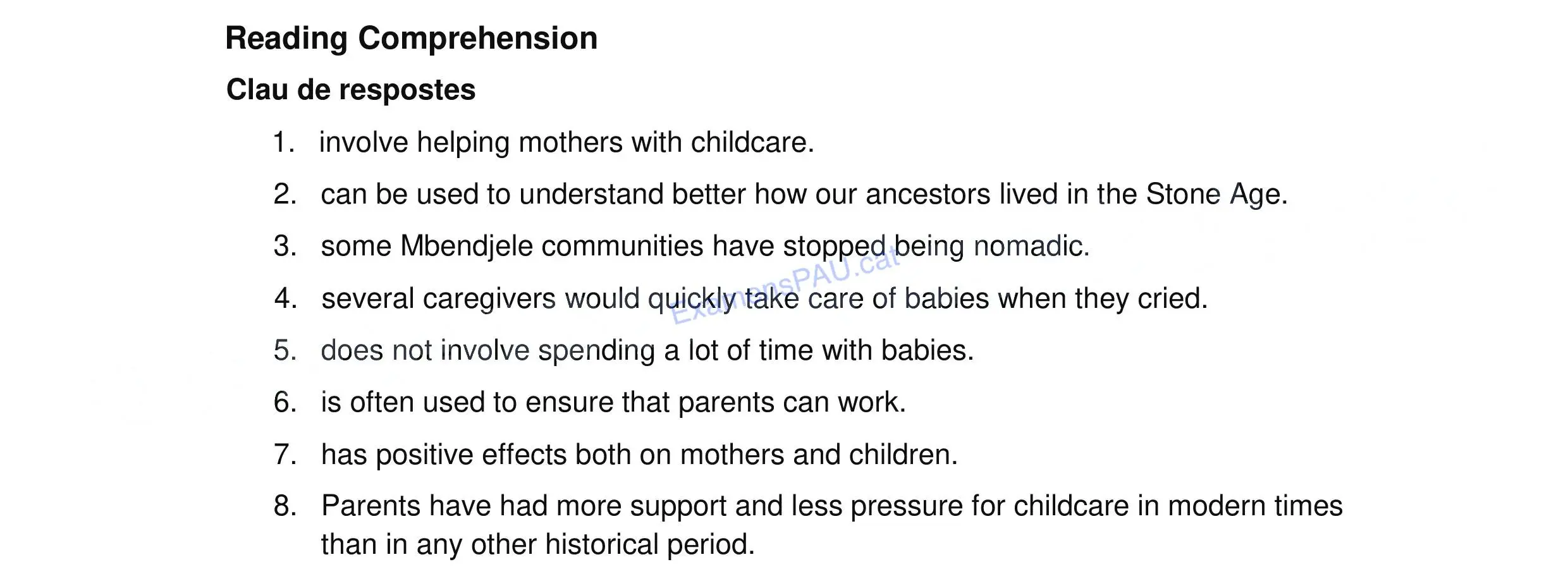
Part 2: Reading comprehension STONE AGE BABIES HAD BETTER PARENTING THAN TODAY! Modern life may have made many things easier, but scientists say that raising a child is certainly not one of them. A study of modern hunter-gatherer groups that has been recently published in the journal Developmental Psychology suggested that our Stone Age ancestors gave their children better childcare than we do today. Researchers from Cambridge University found that children among the Mbendjele BaYaka in the Republic of Congo not only received nine hours of care a day from up to 15 different caregivers, but also that crying children were attended to by either the mother or some individual in the mother's support network more than half of the time, this way giving the mums more time to rest. The study s authors say that these findings suggest that modern parenting methods may be at odds with children's evolutionary programmed needs. Dr Nikhil Chaudhary, lead author of the study, says that insights into these modern hunter- gatherer societies can give us a lot of detail about how humans lived in the Stone Age, which is the period in human prehistory that covers 95 96 of human technological prehistory. "For most of our evolutionary history, humans have lived as hunter-gatherers,” said Dr Chaudhary. “Therefore, contemporary hunter-gatherer communities such as the Mbendjele BaYaka can offer valuable clues as to whether there are certain childbearing systems to which infants, and their mothers, may be psychologically adapted.” The Mbendjele BaYaka are a nomadic group who live in the jungles in the North of the Central African Republic and the Republic of Congo. They are a traditional hunter-gatherer society that practices hunting, fishing, foraging, and honey collection for sustenance. While some Mbendjele communities have become settled and integrated with local economies, many remain mobile and continue to inhabit the forest. Those that are still nomadic live in multifamily camps of between 20 to 80 individuals, consisting of a number of huts in which families live. Evolutionary anthropologists stayed with the Mbendjele BaYaka between March and July 2014, observing children for 12 daylight hours and recording how often they were cared for and by whom. The researchers found that between 10 and 20 different caregivers would be involved in looking after a child and that a mother's support system would respond to more than half of their baby's crying episodes. Furthermore, children were almost never left alone and spent long periods of time in physical contact with adults or receiving close care from them. When children cried they were attended to in under 10 seconds in half of cases and in under 25 seconds 90 % of the time. Older infants and adolescents were also often involved in caregiving, which the report's authors suggest gives them experience and helps reduce anxiety around parenting. This seems to point to the fact that children may be evolutionarily prepared to expect high levels of attention and physical contact from several different caregivers. However, in Western countries the provision of high- quality child support is limited, with parenting manuals often expecting babies to spend extended periods of time playing alone. The study also notes that Stone Age societies may have better prioritized giving mothers a rest. In Western societies, the authors write, it is common for childcare to be used only to give parents time to go to work rather than time for themselves. This means that parents have no time to rest or recover, in total contrast to the parenting practices of both modern hunter-gatherers and our Neolithic ancestors. Co-author and child psychologist Dr Annie Swanepoel says that “support for mothers also has numerous benefits for children such as reducing the risk of neglect and abuse and improving maternal wellbeing, which in turn improves maternal care.” And yet, throughout the whole of human history, it seems that parents have never been under such intense pressure and faced such a lack of support as they do in modern times. Text adapted from an article by William HUNTER. The Daily Mail [online] (November 13, 2023) hunter-gatherer: caçador recollector / cazador-recolector be at odds: estar en desacord / estar en desacuerdo insight: perspectiva childbearing system: sistema de criança / sistema de crianza forage: recollectar al bosc / recolectar en el bosque QUESTIONS Choose the best answer according to the text. Only ONE answer is correct. [3 points: 0.375 points for each correct answer. Wrong answers will be penalized by deducting 0.125 points. There is no penalty for unanswered questions.] 1. According to a recently published article in the journal Developmental Psychology, the Mbendjele BaYala's parenting habits are against children's evolutionary needs. involve helping mothers with childcare. do not allow mothers much time to rest. put children”s evolutionary needs to test. The behavior of modern hunter-gatherer societies such as the Mbendjele BaYaka can be used to understand better how our ancestors lived in the Stone Age. is not representative of how humans lived during prehistory. is the only possible way in which we can understand how humans lived in the Stone Age. cannot help us understand how humans have lived during 95 % of human prehistory. Which of the following statements is TRUE according to the text? All Mbendjele communities live isolated from the rest of civilization. No Mbendjele families live with other families. Some Mbendjele communities have stopped being nomadic. All Mbendjele families continue to be nomadic. Evolutionary anthropologists that stayed with the Mbendjele BaYaka found that only mothers would take care of babies when they cried. it would take caregivers a long time to react to baby s crying episodes. no one would respond to baby's crying episodes. several caregivers would quickly take care of babies when they cried. In comparison to the Mbendjele BaYaka childcare practices, parenting in Western countries does not involve spending a lot of time with babies. always involves older infants and adolescents in caregiving. increases older infants and adolescents” anxiety around childcare. is based on employing more than ten caregivers for every child. In Western societies, childcare is exclusively used to ensure that parents have free time. is often used to ensure that parents can work. is never used to ensure that mothers can go back to work. is always used to ensure that mothers have time to rest. Providing mothers with support improves maternal care but has no effect on children. has very little effect on the mother's wellbeing. has positive effects both on mothers and children. is beneficial for children but does not improve maternal care. Which of the following statements is FALSE? In the present day, parents have more childcare pressure and less support than ever. Parents have never been less supported and felt more childcare pressure than in modern times. As regards childcare, there is more pressure and less support in modern times than in any other historical period. Parents have had more support and less pressure for childcare in modern times than in any other historical period.
#2 Exercici d'examen
Veure solució
Text de l'exercici (transcripció)
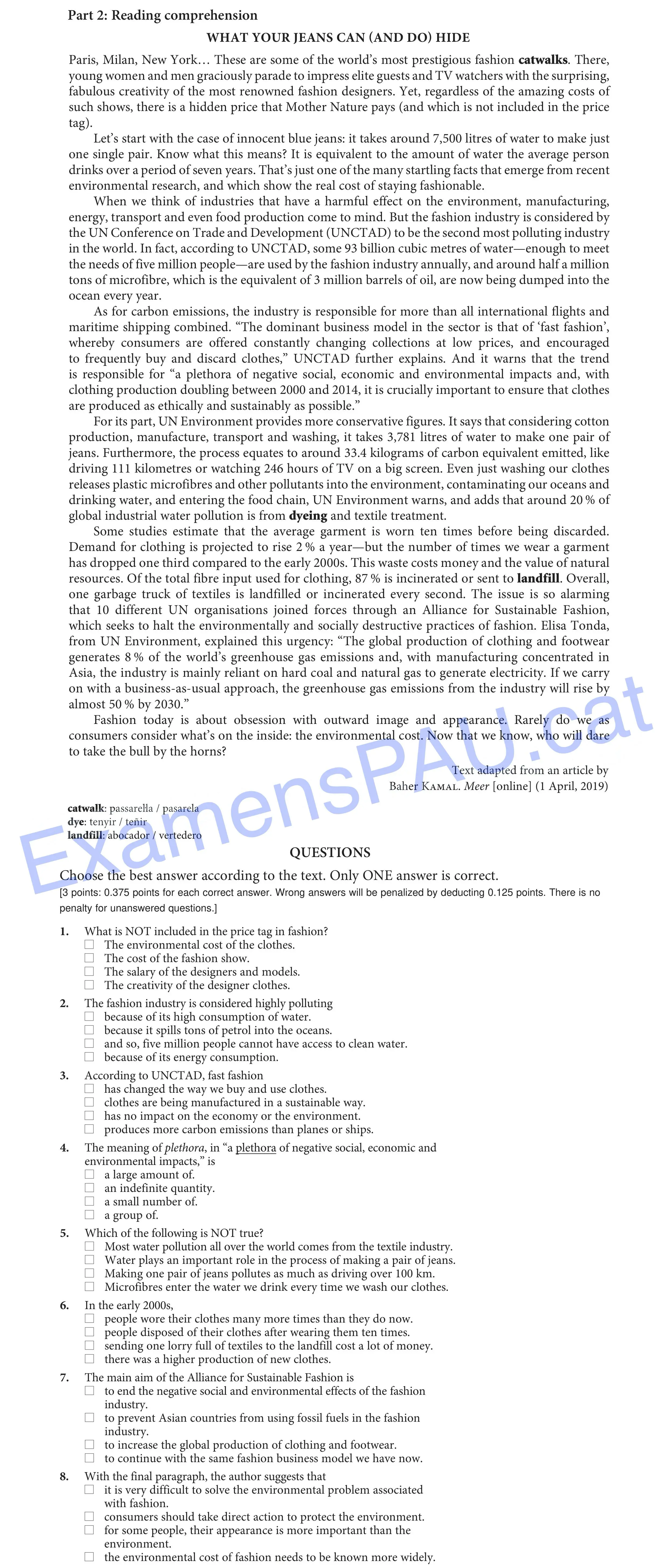
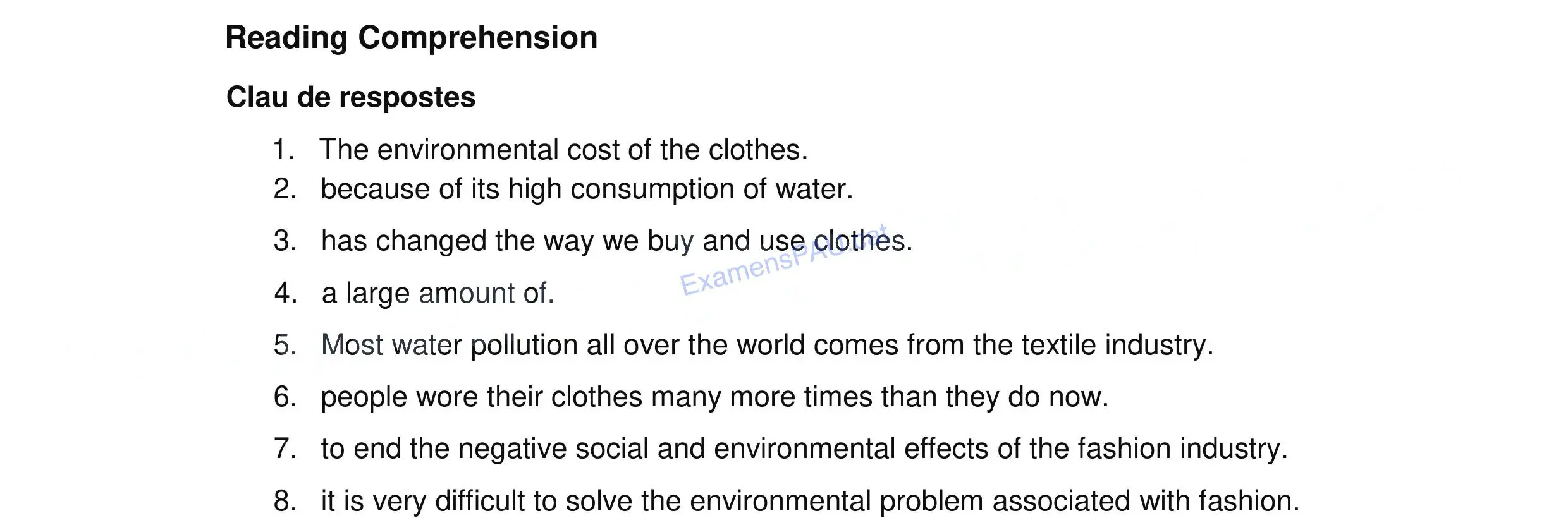
Part 2: Reading comprehension VVHAT YOUR JEANS CAN (AND DO) HIDE Paris, Milan, New York... These are some of the world's most prestigious fashion catwalks. There, young women and men graciously parade to impress elite guests and TV watchers with the surprising, fabulous creativity of the most renowned fashion designers. Yet, regardless of the amazing costs of such shows, there is a hidden price that Mother Nature pays (and which is not included in the price tag). Let's start with the case of innocent blue jeans: it takes around 7,500 litres of water to make just one single pair. Know what this means? It is equivalent to the amount of water the average person drinks over a period of seven years. That's just one of the many startling facts that emerge from recent environmental research, and which show the real cost of staying fashionable. When we think of industries that have a harmful effect on the environment, manufacturing, energy, transport and even food production come to mind. But the fashion industry is considered by the UN Conference on Trade and Development (UNCTAD) to be the second most polluting industry in the world. In fact, according to UNCTAD, some 93 billion cubic metres of water—enough to meet the needs of five million people—are used by the fashion industry annually, and around half a million tons of microfibre, which is the equivalent of 3 million barrels of oil, are now being dumped into the ocean every year. As for carbon emissions, the industry is responsible for more than all international flights and maritime shipping combined. “The dominant business model in the sector is that of “fast fashion”, whereby consumers are offered constantly changing collections at low prices, and encouraged to frequently buy and discard clothes,” UNCTAD further explains. And it warns that the trend is responsible for “a plethora of negative social, economic and environmental impacts and, with clothing production doubling between 2000 and 2014, it is crucially important to ensure that clothes are produced as ethically and sustainably as possible.” For its part, UN Environment provides more conservative figures. It says that considering cotton production, manufacture, transport and washing, it takes 3,781 litres of water to make one pair of jeans. Furthermore, the process equates to around 33.4 kilograms of carbon equivalent emitted, like driving 111 kilometres or watching 246 hours of TV on a big screen. Even just washing our clothes releases plastic microfibres and other pollutants into the environment, contaminating our oceans and drinking water, and entering the food chain, UN Environment warns, and adds that around 20 % of global industrial water pollution is from dyeing and textile treatment. Some studies estimate that the average garment is worn ten times before being discarded. Demand for clothing is projected to rise 2% a year—but the number of times we wear a garment has dropped one third compared to the early 2000s. This waste costs money and the value of natural resources. Of the total fibre input used for clothing, 87 % is incinerated or sent to landfill. Overall, one garbage truck of textiles is landfilled or incinerated every second. The issue is so alarming that 10 different UN organisations joined forces through an Alliance for Sustainable Fashion, which seeks to halt the environmentally and socially destructive practices of fashion. Elisa Tonda, from UN Environment, explained this urgency: “The global production of clothing and footwear generates 8 96 of the world's greenhouse gas emissions and, with manufacturing concentrated in Asia, the industry is mainly reliant on hard coal and natural gas to generate electricity. If we carry on with a business-as-usual approach, the greenhouse gas emissions from the industry will rise by almost 50 % by 2030.” Fashion today is about obsession with outward image and appearance. Rarely do we as consumers consider what's on the inside: the environmental cost. Now that we know, who will dare to take the bull by the horns? Text adapted from an article by Baher KamaL. Meer [online] (1 April, 2019) catwalk: passarella / pasarela dye: tenyir / teñir landfill: abocador / vertedero QUESTIONS Choose the best answer according to the text. Only ONE answer is correct. [3 points: 0.375 points for each correct answer. Wrong answers will be penalized by deducting 0.125 points. There is no penalty for unanswered questions.] 1. What is NOT included in the price tag in fashion? The environmental cost of the clothes. The cost of the fashion show. The salary of the designers and models. The creativity of the designer clothes. The fashion industry is considered highly polluting because of its high consumption of water. because it spills tons of petrol into the oceans. and so, five million people cannot have access to clean water. because of its energy consumption. ccording to UNCTAD, fast fashion has changed the way we buy and use clothes. clothes are being manufactured in a sustainable way. has no impact on the economy or the environment. produces more carbon emissions than planes or ships. > The meaning of plethora, in “a plethora of negative social, economic and environmental impacts,” is a large amount of. an indefinite quantity. a small number of. a group of. Which of the following is NOT true? Most water pollution all over the world comes from the textile industry. Water plays an important role in the process of making a pair of jeans. Making one pair of jeans pollutes as much as driving over 100 km. Microfibres enter the water we drink every time we wash our clothes. In the early 2000s, people wore their clothes many more times than they do now. people disposed of their clothes after wearing them ten times. sending one lorry full of textiles to the landfill cost a lot of money. there was a higher production of new clothes. The main aim of the Alliance for Sustainable Fashion is to end the negative social and environmental effects of the fashion industry. to prevent Asian countries from using fossil fuels in the fashion industry. to increase the global production of clothing and footwear. to continue with the same fashion business model we have now. With the final paragraph, the author suggests that it is very difficult to solve the environmental problem associated with fashion. consumers should take direct action to protect the environment. for some people, their appearance is more important than the environment. the environmental cost of fashion needs to be known more widely.
#3 Exercici d'examen
Veure solució
Text de l'exercici (transcripció)
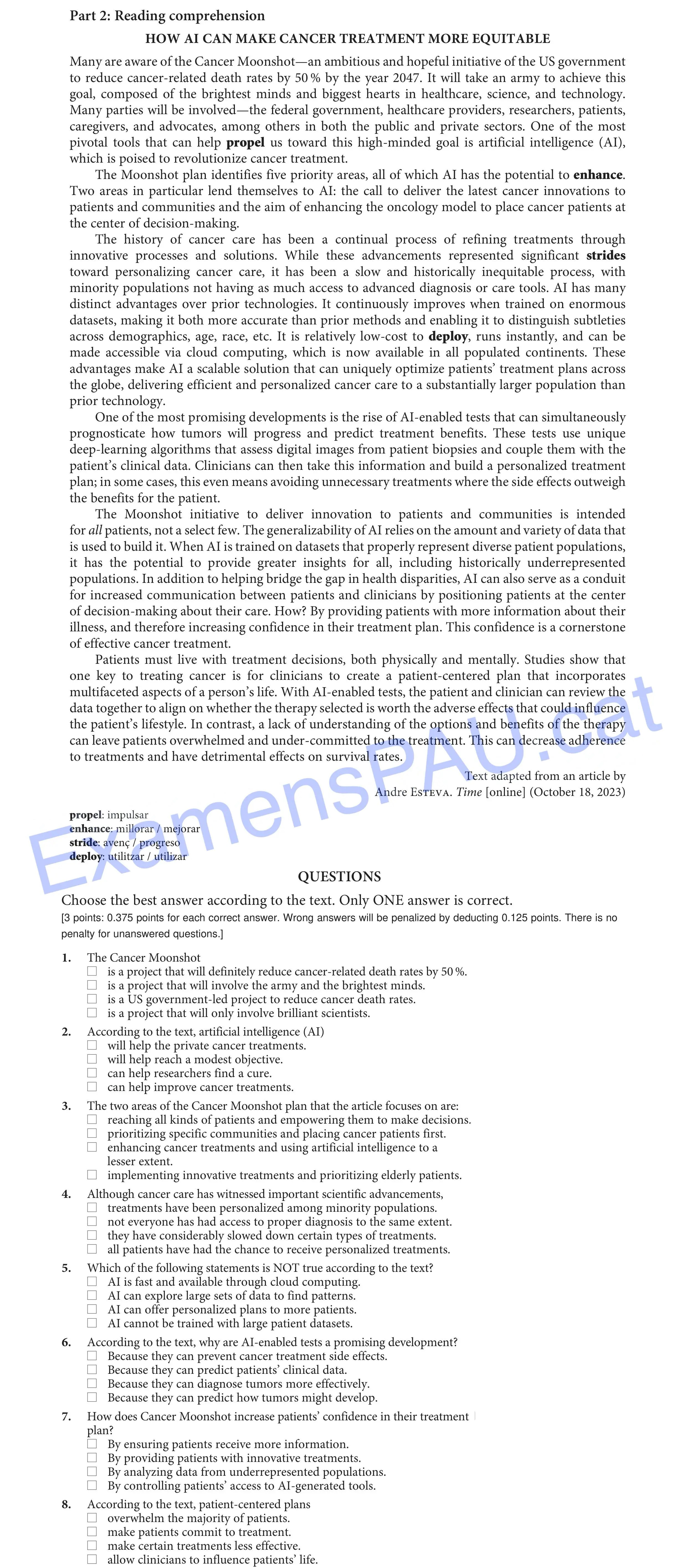
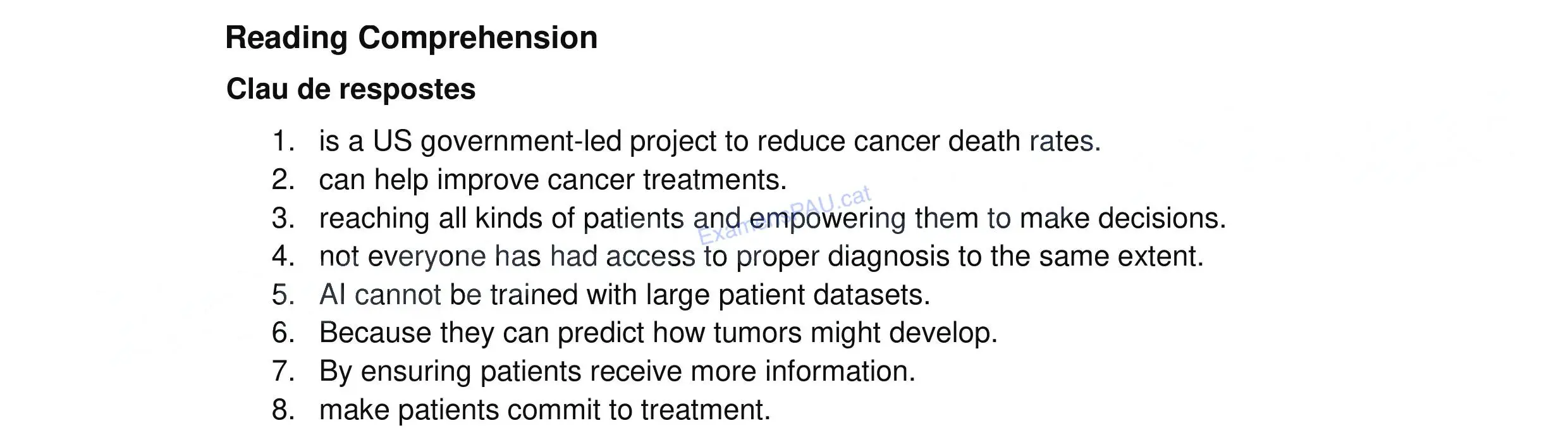
Part 2: Reading comprehension HOW AI CAN MARE CANCER TREATMENT MORE EQUITABLE Many are aware of the Cancer Moonshot—an ambitious and hopeful initiative of the US government to reduce cancer-related death rates by 50% by the year 2047. It will take an army to achieve this goal, composed of the brightest minds and biggest hearts in healthcare, science, and technology. Many parties will be involved—the federal government, healthcare providers, researchers, patients, caregivers, and advocates, among others in both the public and private sectors. One of the most pivotal tools that can help propel us toward this high-minded goal is artificial intelligence (AI), which is poised to revolutionize cancer treatment. The Moonshot plan identifies five priority areas, all of which Al has the potential to enhance. Two areas in particular lend themselves to Al: the call to deliver the latest cancer innovations to patients and communities and the aim of enhancing the oncology model to place cancer patients at the center of decision-making. The history of cancer care has been a continual process of refining treatments through innovative processes and solutions. While these advancements represented significant strides toward personalizing cancer care, it has been a slow and historically inequitable process, with minority populations not having as much access to advanced diagnosis or care tools. Al has many distinct advantages over prior technologies. It continuously improves when trained on enormous datasets, making it both more accurate than prior methods and enabling it to distinguish subtleties across demographics, age, race, etc. It is relatively low-cost to deploy, runs instantly, and can be made accessible via cloud computing, which is now available in all populated continents. These advantages make Al a scalable solution that can uniquely optimize patients” treatment plans across the globe, delivering efficient and personalized cancer care to a substantially larger population than prior technology. One of the most promising developments is the rise of Al-enabled tests that can simultaneously prognosticate how tumors will progress and predict treatment benefits. These tests use unique deep-learning algorithms that assess digital images from patient biopsies and couple them with the patient's clinical data. Clinicians can then take this information and build a personalized treatment plan; in some cases, this even means avoiding unnecessary treatments where the side effects outweigh the benefits for the patient. The Moonshot initiative to deliver innovation to patients and communities is intended for all patients, not a select few. The generalizability of AI relies on the amount and variety of data that is used to build it. When Al is trained on datasets that properly represent diverse patient populations, it has the potential to provide greater insights for all, including historically underrepresented populations. In addition to helping bridge the gap in health disparities, Al can also serve as a conduit for increased communication between patients and clinicians by positioning patients at the center of decision-making about their care. How? By providing patients with more information about their illness, and therefore increasing confidence in their treatment plan. This confidence is a cornerstone of effective cancer treatment. Patients must live with treatment decisions, both physically and mentally. Studies show that one key to treating cancer is for clinicians to create a patient-centered plan that incorporates multifaceted aspects of a person's life. With Al-enabled tests, the patient and clinician can review the data together to align on whether the therapy selected is worth the adverse effects that could influence the patient's lifestyle. In contrast, a lack of understanding of the options and benefits of the therapy can leave patients overwhelmed and under-committed to the treatment. This can decrease adherence to treatments and have detrimental effects on survival rates. Text adapted from an article by Andre ESTEVA. Time [online] (October 18, 2023) propel: impulsar enhance: millorar / mejorar stride: avenç / progreso deploy: utilitzar / utilizar QUESTIONS Choose the best answer according to the text. Only ONE answer is correct. [3 points: 0.375 points for each correct answer. Wrong answers will be penalized by deducting 0.125 points. There is no penalty for unanswered questions.] 1. The Cancer Moonshot is a project that will definitely reduce cancer-related death rates by 50%. is a project that will involve the army and the brightest minds. is a US government-led project to reduce cancer death rates. is a project that will only involve brilliant scientists. 2. According to the text, artificial intelligence (AI) will help the private cancer treatments. will help reach a modest objective. can help researchers find a cure. can help improve cancer treatments. 3. The two areas of the Cancer Moonshot plan that the article focuses on are: reaching all kinds of patients and empowering them to make decisions. prioritizing specific communities and placing cancer patients first. enhancing cancer treatments and using artificial intelligence to a lesser extent. implementing innovative treatments and prioritizing elderly patients. 4. Although cancer care has vvitnessed important scientific advancements, treatments have been personalized among minority populations. not everyone has had access to proper diagnosis to the same extent. they have considerably slowed down certain types of treatments. all patients have had the chance to receive personalized treatments. 5. Which of the following statements is NOT true according to the text? Al is fast and available through cloud computing. Al can explore large sets of data to find patterns. Al can offer personalized plans to more patients. Al cannot be trained with large patient datasets. 6. According to the text, why are Al-enabled tests a promising development? Because they can prevent cancer treatment side effects. Because they can predict patients” clinical data. Because they can diagnose tumors more effectively. Because they can predict how tumors might develop. 7. How does Cancer Moonshot increase patients” confidence in their treatment plan? By ensuring patients receive more information. By providing patients with innovative treatments. By analyzing data from underrepresented populations. By controlling patients” access to Al-generated tools. 8. According to the text, patient-centered plans overwhelm the majority of patients. make patients commit to treatment. make certain treatments less effective. allow clinicians to influence patients” life.
#4 Exercici d'examen
Veure solució
Text de l'exercici (transcripció)
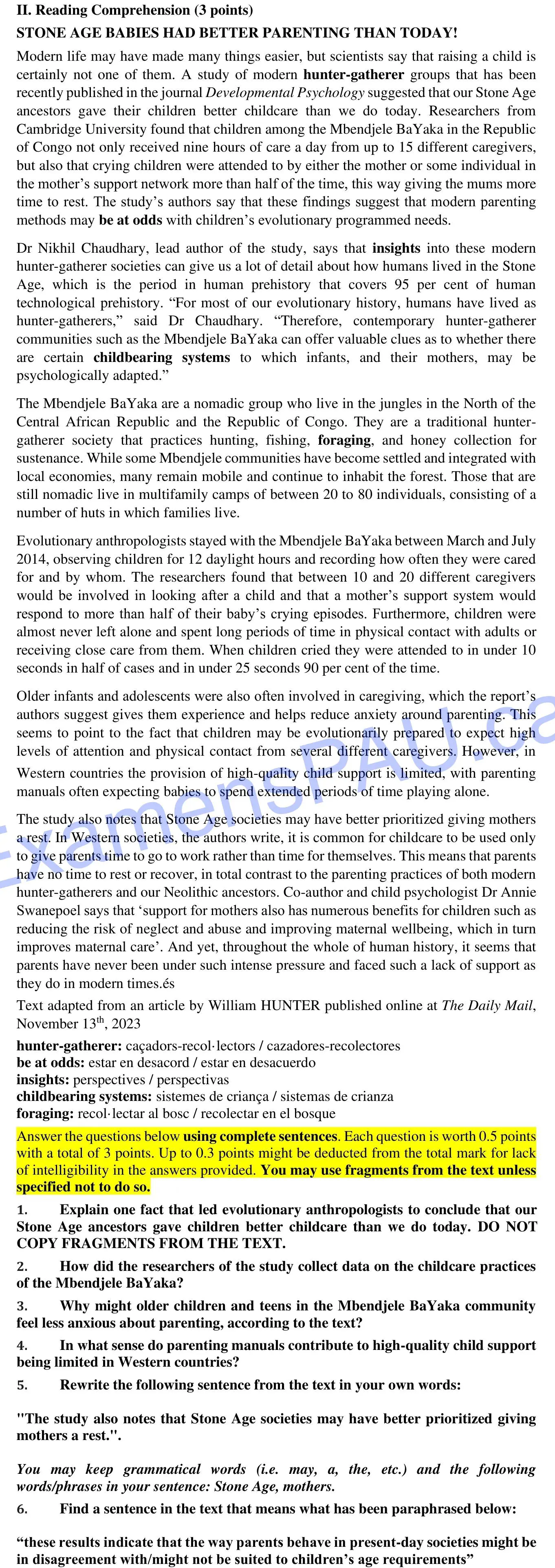
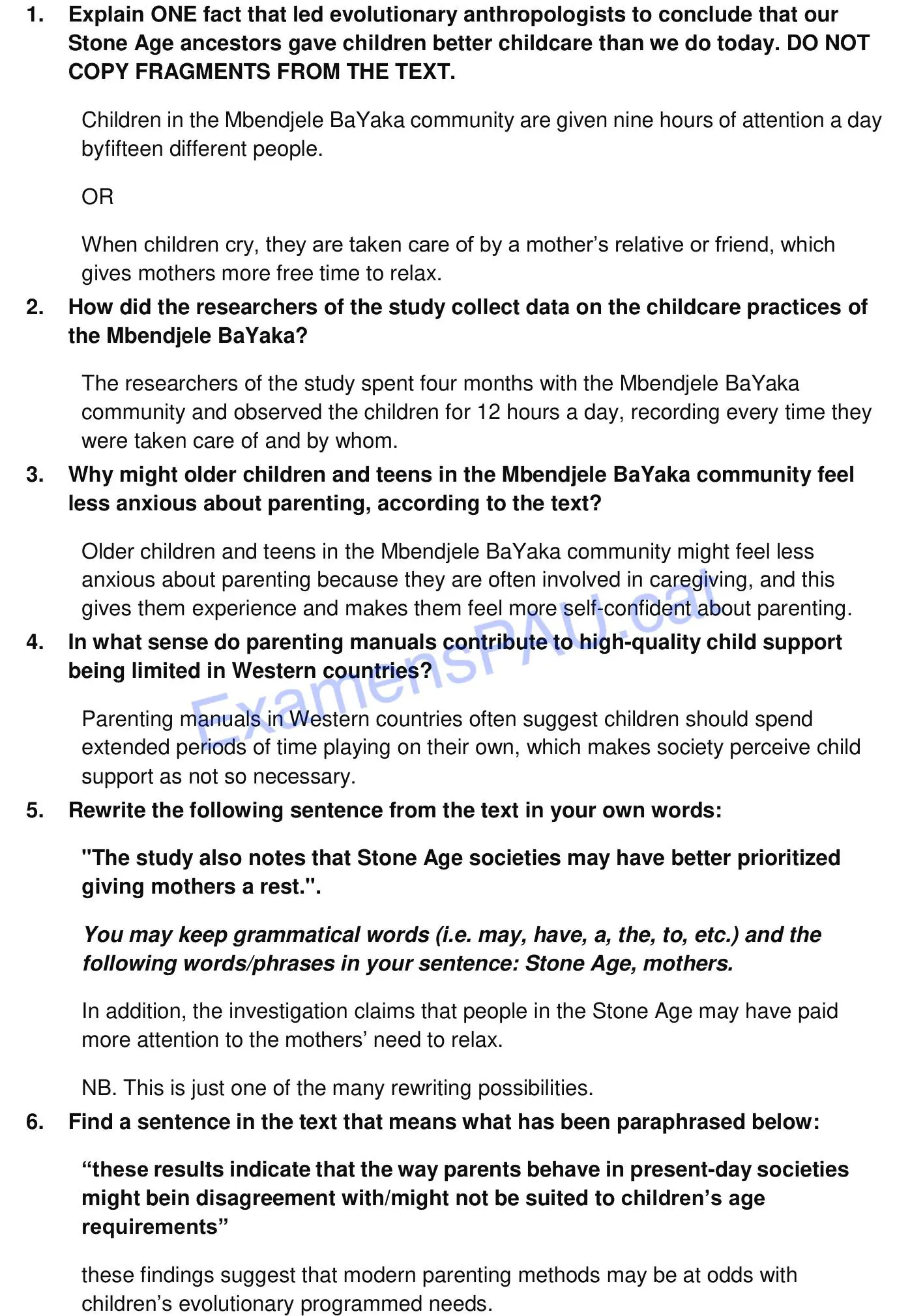
HI. Reading Comprehension (3 points) STONE AGE BABIES HAD BETTER PARENTING THAN TODAY! Modern life may have made many things easier, but scientists say that raising a child is certainly not one of them. A study of modern hunter-gatherer groups that has been recently published in the journal Developmental Psychology suggested that our Stone Age ancestors gave their children better childcare than we do today. Researchers from Cambridge University found that children among the Mbendjele BaYaka in the Republic of Congo not only received nine hours of care a day from up to 15 different caregivers, but also that crying children were attended to by either the mother or some individual in the mother”s support network more than half of the time, this way giving the mums more time to rest. The study's authors say that these findings suggest that modern parenting methods may be at odds with children's evolutionary programmed needs. Dr Nikhil Chaudhary, lead author of the study, says that insights into these modern hunter-gatherer societies can give us a lot of detail about how humans lived in the Stone Age, which is the period in human prehistory that covers 95 per cent of human technological prehistory. “For most of our evolutionary history, humans have lived as hunter-gatherers,” said Dr Chaudhary. “Therefore, contemporary hunter-gatherer communities such as the Mbendjele BaYaka can offer valuable clues as to whether there are certain childbearing systems to which infants, and their mothers, may be psychologically adapted.” The Mbendjele BaYaka are a nomadic group who live in the jungles in the North of the Central African Republic and the Republic of Congo. They are a traditional hunter- gatherer society that practices hunting, fishing, foraging, and honey collection for sustenance. While some Mbendjele communities have become settled and integrated with local economies, many remain mobile and continue to inhabit the forest. Those that are still nomadic live in multifamily camps of between 20 to 80 individuals, consisting of a number of huts in which families live. Evolutionary anthropologists stayed with the Mbendjele BaYaka between March and July 2014, observing children for 12 daylight hours and recording how often they were cared for and by whom. The researchers found that between 10 and 20 different caregivers would be involved in looking after a child and that a mother's support system would respond to more than half of their baby”s crying episodes. Furthermore, children were almost never left alone and spent long periods of time in physical contact with adults or receiving close care from them. When children cried they were attended to in under 10 seconds in half of cases and in under 25 seconds 90 per cent of the time. Older infants and adolescents were also often involved in caregiving, which the report's authors suggest gives them experience and helps reduce anxiety around parenting. This seems to point to the fact that children may be evolutionarily prepared to expect high levels of attention and physical contact from several different caregivers. However, in Western countries the provision of high-quality child support is limited, with parenting manuals often expecting babies to spend extended periods of time playing alone. The study also notes that Stone Age societies may have better prioritized giving mothers a rest. In Western societies, the authors write, it is common for childcare to be used only to give parents time to go to work rather than time for themselves. This means that parents have no time to rest or recover, in total contrast to the parenting practices of both modern hunter-gatherers and our Neolithic ancestors. Co-author and child psychologist Dr Annie Swanepoel says that “support for mothers also has numerous benefits for children such as reducing the risk of neglect and abuse and improving maternal wellbeing, which in turn improves maternal care”. And yet, throughout the whole of human history, it seems that parents have never been under such intense pressure and faced such a lack of support as they do in modern times.és Text adapted from an article by William HUNTER published online at The Daily Mail, November 13'*, 2023 hunter-gatherer: caçadors-recol:lectors / cazadores-recolectores be at odds: estar en desacord / estar en desacuerdo insights: perspectives / perspectivas childbearing systems: sistemes de criança / sistemas de crianza foraging: recol-lectar al bosc / recolectar en el bosque 1. Explain one fact that led evolutionary anthropologists to conclude that our Stone Age ancestors gave children better childcare than we do today. DO NOT COPY FRAGMENTS FROM THE TEXT. 2. How did the researchers of the study collect data on the childcare practices of the Mbendjele BaYaka? 3. Why might older children and teens in the Mbendjele BaYaka community feel less anxious about parenting, according to the text? 4. In what sense do parenting manuals contribute to high-quality child support being limited in Western countries? 5. Rewrite the following sentence from the text in your own words: "The study also notes that Stone Age societies may have better prioritized giving mothers a rest.'". You may keep grammatical words (i.e. may, a, the, etc.) and the following words/phrases in your sentence: Stone Age, mothers. 6. Find a sentence in the text that means what has been paraphrased below: “these results indicate that the way parents behave in present-day societies might be in disagreement with/might not be suited to children”s age requirements”
#5 Exercici d'examen
Veure solució

Text de l'exercici (transcripció)
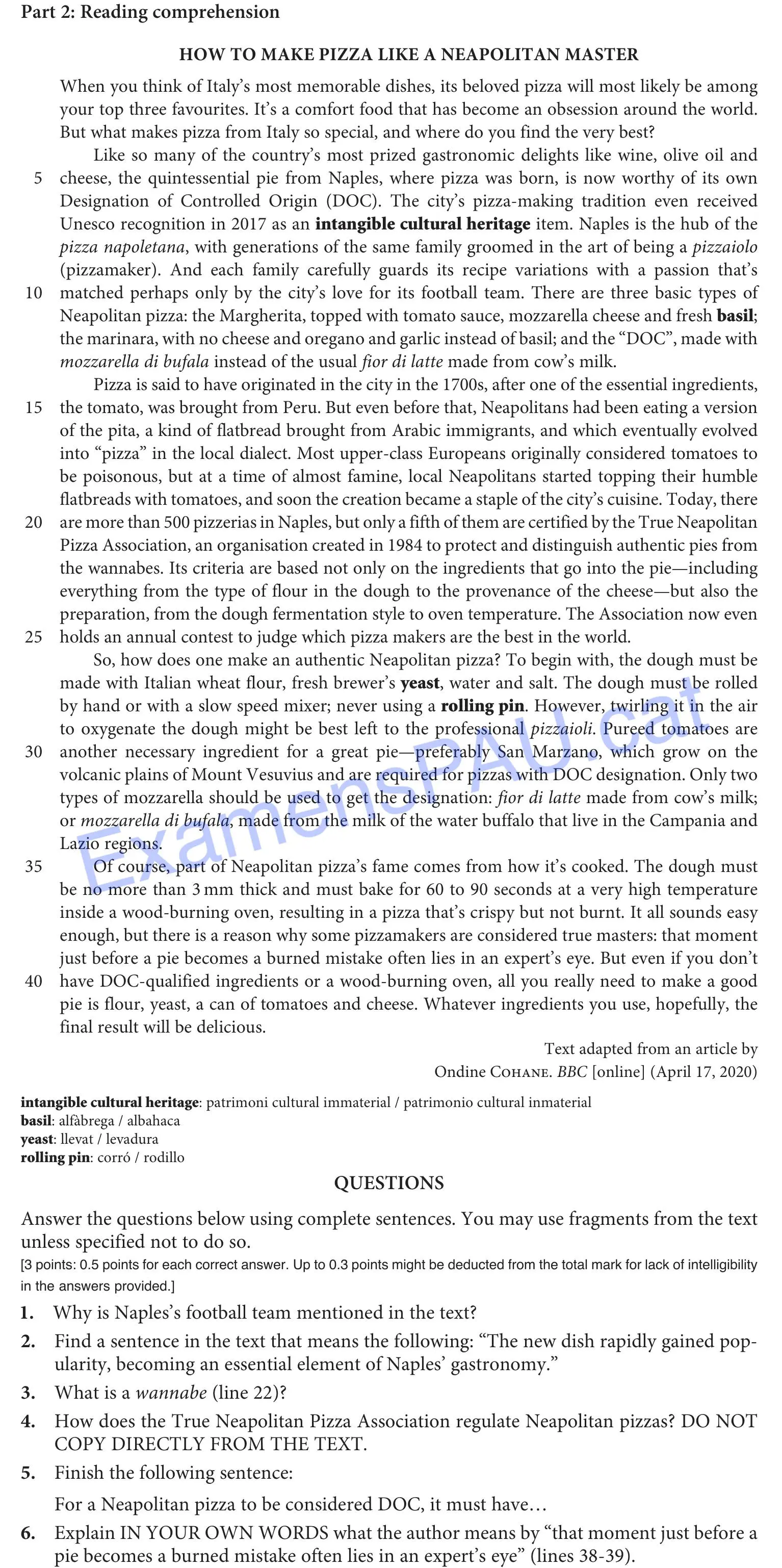
Part 2: Reading comprehension HOV TO MARE PIZZA LIRE A NEAPOLITAN MASTER When you think of Italy's most memorable dishes, its beloved pizza will most likely be among your top three favourites. It's a comfort food that has become an obsession around the world. But what makes pizza from Italy so special, and where do you find the very best? Like so many of the country's most prized gastronomic delights like wine, olive oil and 5 cheese, the quintessential pie from Naples, where pizza was born, is now worthy of its own Designation of Controlled Origin (DOC). The city's pizza-making tradition even received Unesco recognition in 2017 as an intangible cultural heritage item. Naples is the hub of the pizza napoletana, with generations of the same family groomed in the art of being a pizzaiolo (pizzamaker). And each family carefully guards its recipe variations with a passion that's 10 matched perhaps only by the city's love for its football team. There are three basic types of Neapolitan pizza: the Margherita, topped with tomato sauce, mozzarella cheese and fresh basil; the marinara, with no cheese and oregano and garlic instead of basil; and the “DOC”, made with mozzarella di bufala instead of the usual fior di latte made from cow's milk. Pizza is said to have originated in the city in the 1700s, after one of the essential ingredients, 15 the tomato, was brought from Peru. But even before that, Neapolitans had been eating a version of the pita, a kind of flatbread brought from Arabic immigrants, and which eventually evolved into “pizza” in the local dialect. Most upper-class Europeans originally considered tomatoes to be poisonous, but at a time of almost famine, local Neapolitans started topping their humble flatbreads with tomatoes, and soon the creation became a staple of the city's cuisine. Today, there 20 are more than 500 pizzerias in Naples, but only a fifth of them are certified by the True Neapolitan Pizza Association, an organisation created in 1984 to protect and distinguish authentic pies from the wannabes. Its criteria are based not only on the ingredients that go into the pie—including everything from the type of flour in the dough to the provenance of the cheese—but also the preparation, from the dough fermentation style to oven temperature. The Association now even 25 holds an annual contest to judge which pizza makers are the best in the world. So, how does one make an authentic Neapolitan pizza? To begin with, the dough must be made with Italian wheat flour, fresh brewer's yeast, water and salt. The dough must be rolled by hand or with a slow speed mixer; never using a rolling pin. However, twirling it in the air to oxygenate the dough might be best left to the professional pizzaioli. Pureed tomatoes are 30 another necessary ingredient for a great pie—preferably San Marzano, which grow on the volcanic plains of Mount Vesuvius and are required for pizzas with DOC designation. Only two types of mozzarella should be used to get the designation: fior di latte made from cow's milk; or mozzarella di bufala, made from the milk of the water buffalo that live in the Campania and Lazio regions. 35 Of course, part of Neapolitan pizza's fame comes from how it's cooked. The dough must be no more than 3 mm thick and must bake for 60 to 90 seconds at a very high temperature inside a wood-burning oven, resulting in a pizza that's crispy but not burnt. It all sounds easy enough, but there is a reason why some pizzamakers are considered true masters: that moment just before a pie becomes a burned mistake often lies in an expert's eye. But even if you don't 40 have DOC-qualified ingredients or a wood-burning oven, all you really need to make a good pie is flour, yeast, a can of tomatoes and cheese. Whatever ingredients you use, hopefully, the final result will be delicious. Text adapted from an article by Ondine COHANE. BBC [online] (April 17, 2020) intangible cultural heritage: patrimoni cultural immaterial / patrimonio cultural inmaterial basil: alfabrega / albahaca yeast: llevat / levadura rolling pin: corró / rodillo QUESTIONS Answer the questions below using complete sentences. You may use fragments from the text unless specified not to do so. [8 points: 0.5 points for each correct answer. Up to 0.3 points might be deducted from the total mark for lack of intelligibility in the answers provided.] 1. Why is Naples's football team mentioned in the text? 2. Find a sentence in the text that means the following: “The new dish rapidly gained pop- ularity, becoming an essential element of Naples” gastronomy.” 3. Whatis a wannabe (line 22)? How does the True Neapolitan Pizza Association regulate Neapolitan pizzas? DO NOT COPY DIRECTLY FROM THE TEXT. 5. Finish the following sentence: For a Neapolitan pizza to be considered DOC, it must have... 6. Explain IN YOUR OWN WORDS what the author means by “that moment just before a pie becomes a burned mistake often lies in an expert's eye” (lines 38-39).
#6 Exercici d'examen
Veure solució
Text de l'exercici (transcripció)
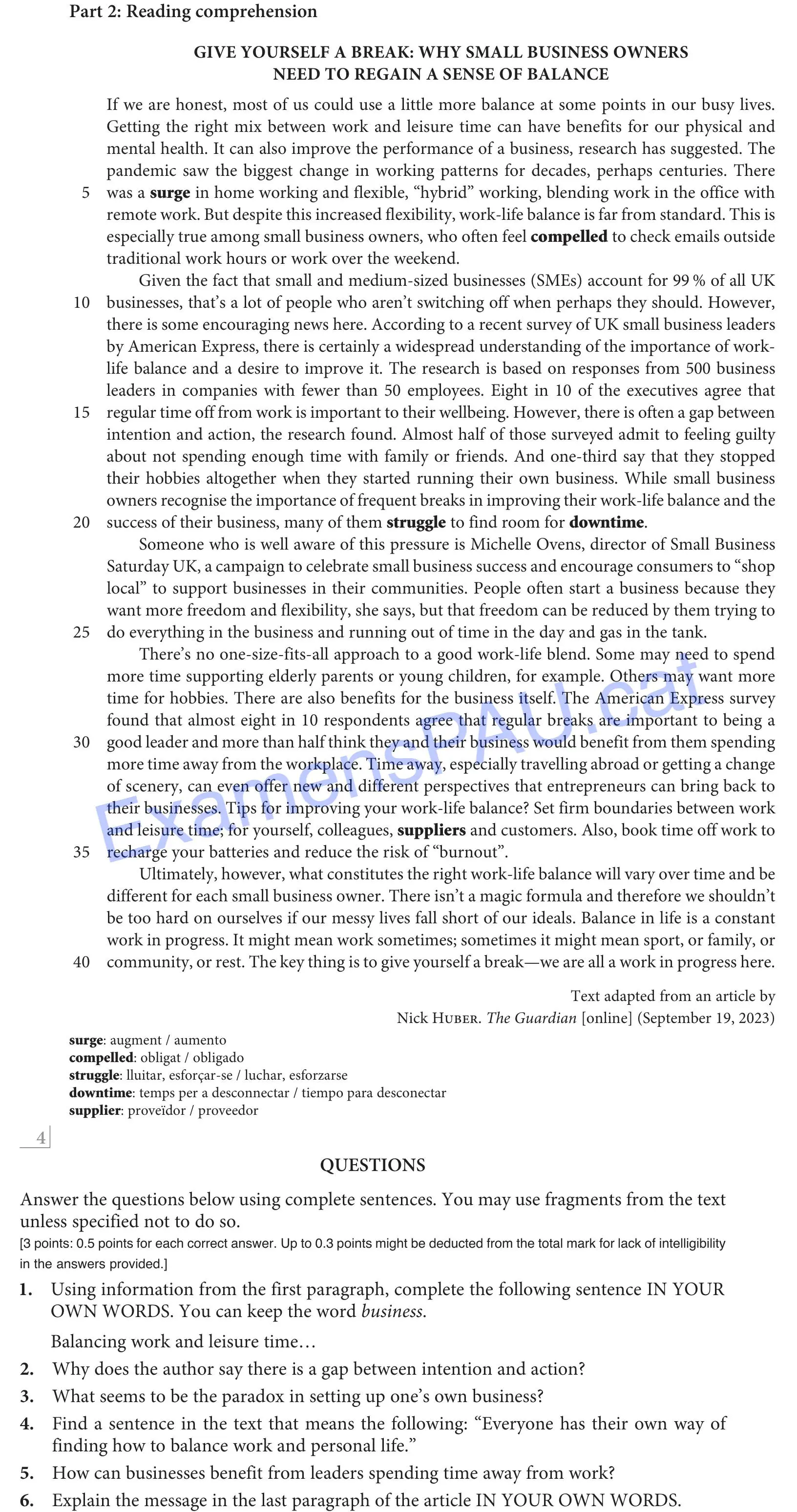
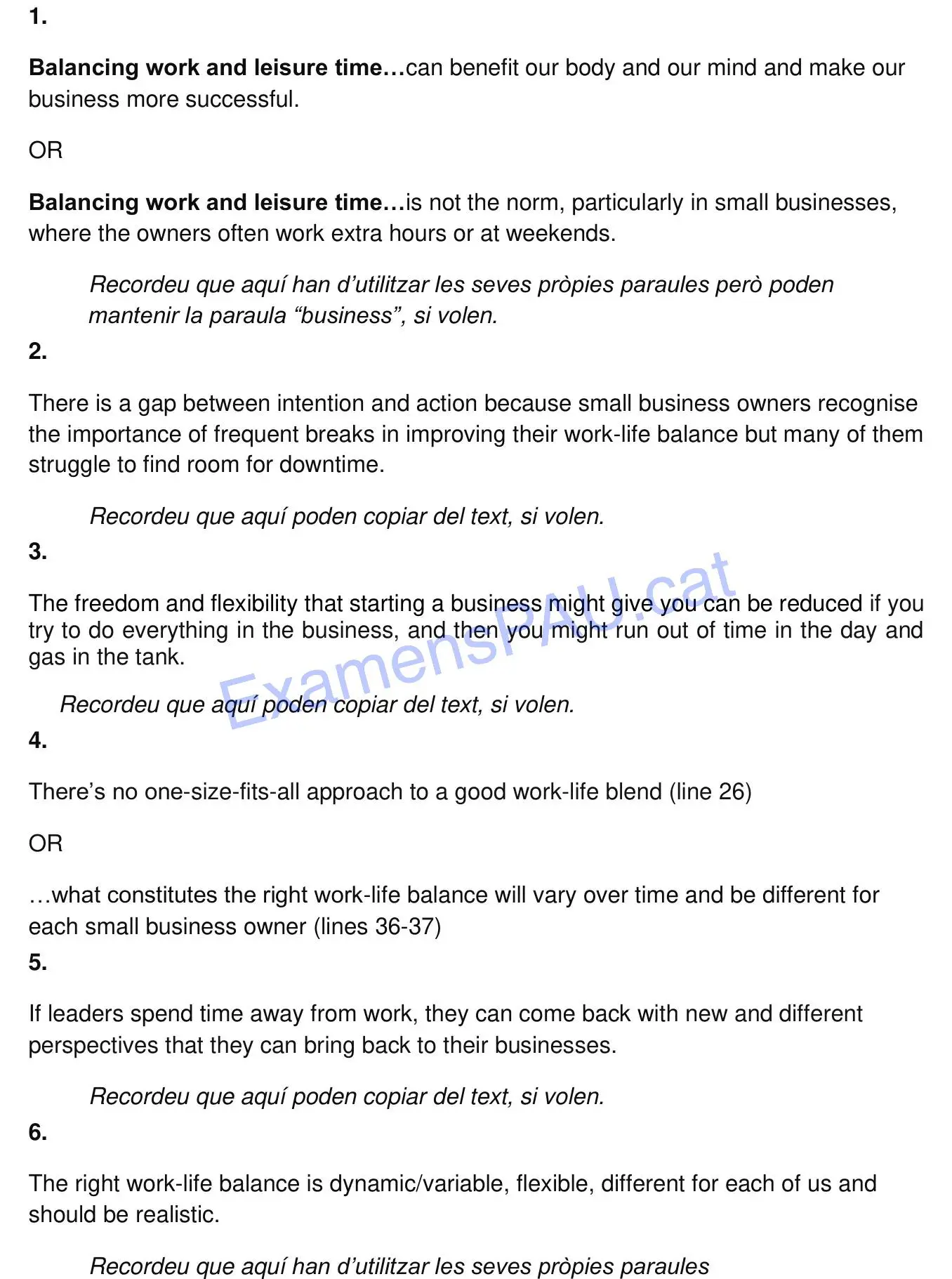
Part 2: Reading comprehension 10 15 20 25 30 35 40 GIVE YOURSELF A BREAK: WHY SMALL BUSINESS OWNERS NEED TO REGAIN A SENSE OF BALANCE If we are honest, most of us could use a little more balance at some points in our busy lives. Getting the right mix between work and leisure time can have benefits for our physical and mental health. It can also improve the performance of a business, research has suggested. The pandemic saw the biggest change in working patterns for decades, perhaps centuries. There was a surge in home working and flexible, “hybrid” working, blending work in the office with remote work. But despite this increased flexibility, work-life balance is far from standard. This is especially true among small business owners, who often feel compelled to check emails outside traditional work hours or work over the weekend. Given the fact that small and medium-sized businesses (SMEs) account for 99 % of all UK businesses, that's a lot of people who aren't switching off when perhaps they should. However, there is some encouraging news here. According to a recent survey of UK small business leaders by American Express, there is certainly a widespread understanding of the importance of work- life balance and a desire to improve it. The research is based on responses from 500 business leaders in companies with fewer than 50 employees. Eight in 10 of the executives agree that regular time off from work is important to their wellbeing. However, there is often a gap between intention and action, the research found. Almost half of those surveyed admit to feeling guilty about not spending enough time with family or friends. And one-third say that they stopped their hobbies altogether when they started running their own business. While small business owners recognise the importance of frequent breaks in improving their work-life balance and the success of their business, many of them struggle to find room for downtime. Someone who is well aware of this pressure is Michelle Ovens, director of Small Business Saturday UK, a campaign to celebrate small business success and encourage consumers to “shop local” to support businesses in their communities. People often start a business because they want more freedom and flexibility, she says, but that freedom can be reduced by them trying to do everything in the business and running out of time in the day and gas in the tank. There's no one-size-fits-all approach to a good work-life blend. Some may need to spend more time supporting elderly parents or young children, for example. Others may want more time for hobbies. There are also benefits for the business itself. The American Express survey found that almost eight in 10 respondents agree that regular breaks are important to being a good leader and more than half think they and their business would benefit from them spending more time away from the workplace. Time away, especially travelling abroad or getting a change of scenery, can even offer new and different perspectives that entrepreneurs can bring back to their businesses. Tips for improving your work-life balance? Set firm boundaries between work and leisure time; for yourself, colleagues, suppliers and customers. Also, book time off work to recharge your batteries and reduce the risk of “burnout”. Ultimately, however, what constitutes the right work-life balance will vary over time and be different for each small business owner. There isn't a magic formula and therefore we shouldn't be too hard on ourselves if our messy lives fall short of our ideals. Balance in life is a constant work in progress. It might mean work sometimes; sometimes it might mean sport, or family, or community, or rest. The key thing is to give yourself a break—we are all a work in progress here. Text adapted from an article by Nick HUBER. The Guardian [online] (September 19, 2023) surge: augment / aumento compelled: obligat / obligado struggle: lluitar, esforçar-se / luchar, esforzarse downtime: temps per a desconnectar / tiempo para desconectar supplier: proveidor / proveedor 4] QUESTIONS Answer the questions below using complete sentences. You may use fragments from the text unless specified not to do so. (3 points: 0.5 points for each correct answer. Up to 0.3 points might be deducted from the total mark for lack of intelligibility in the answers provided.] 1. Using information from the first paragraph, complete the following sentence IN YOUR OWN WORDS. You can keep the word business. Balancing work and leisure time... 2. Why does the author say there is a gap between intention and action? 3. What seems to be the paradox in setting up one's own business? Find a sentence in the text that means the following: “Everyone has their own way of finding how to balance work and personal life.” 5. How can businesses benefit from leaders spending time away from work? Explain the message in the last paragraph of the article IN YOUR OWN WORDS.
#7 Exercici d'examen
Veure solució
Text de l'exercici (transcripció)
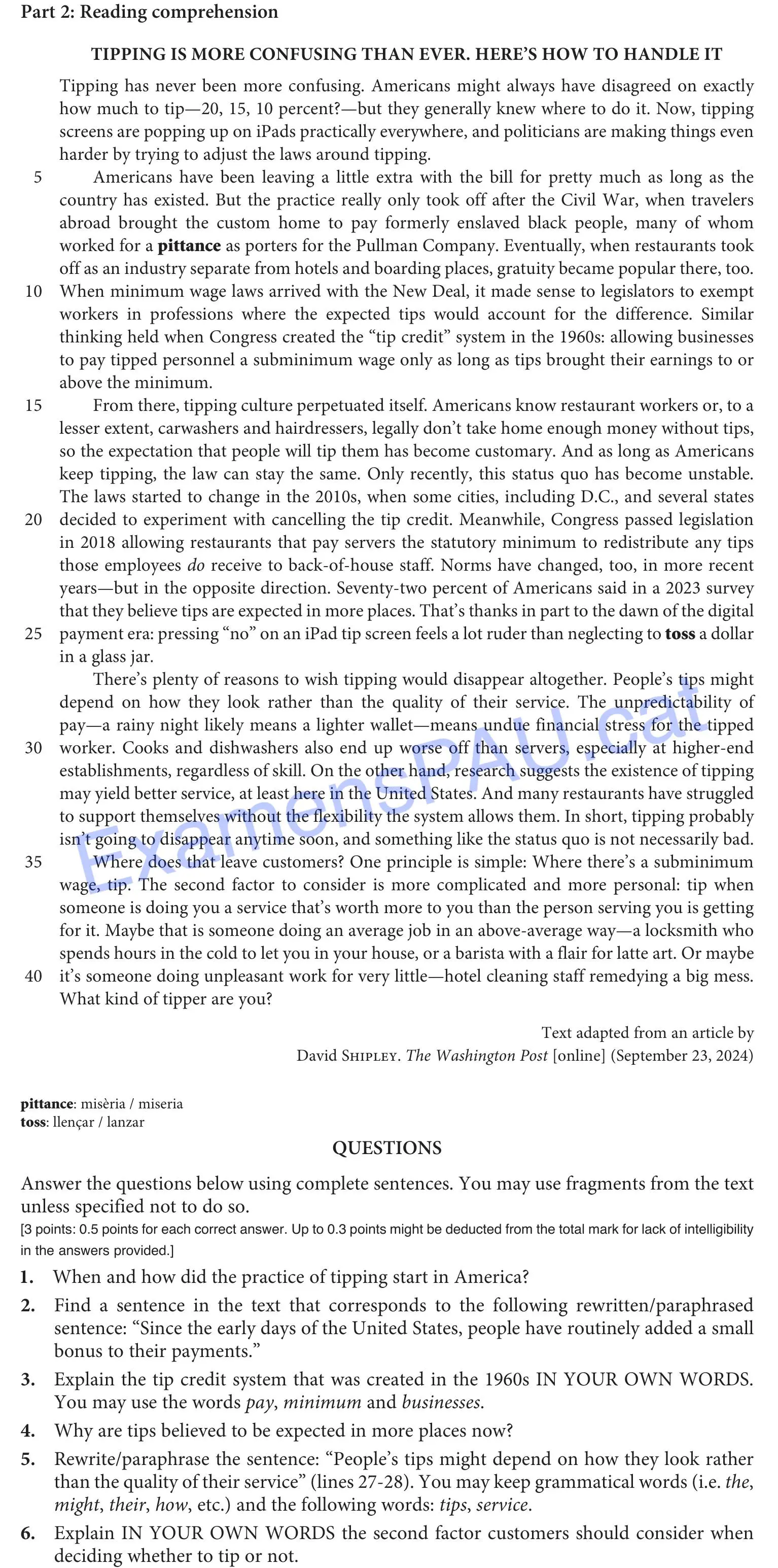
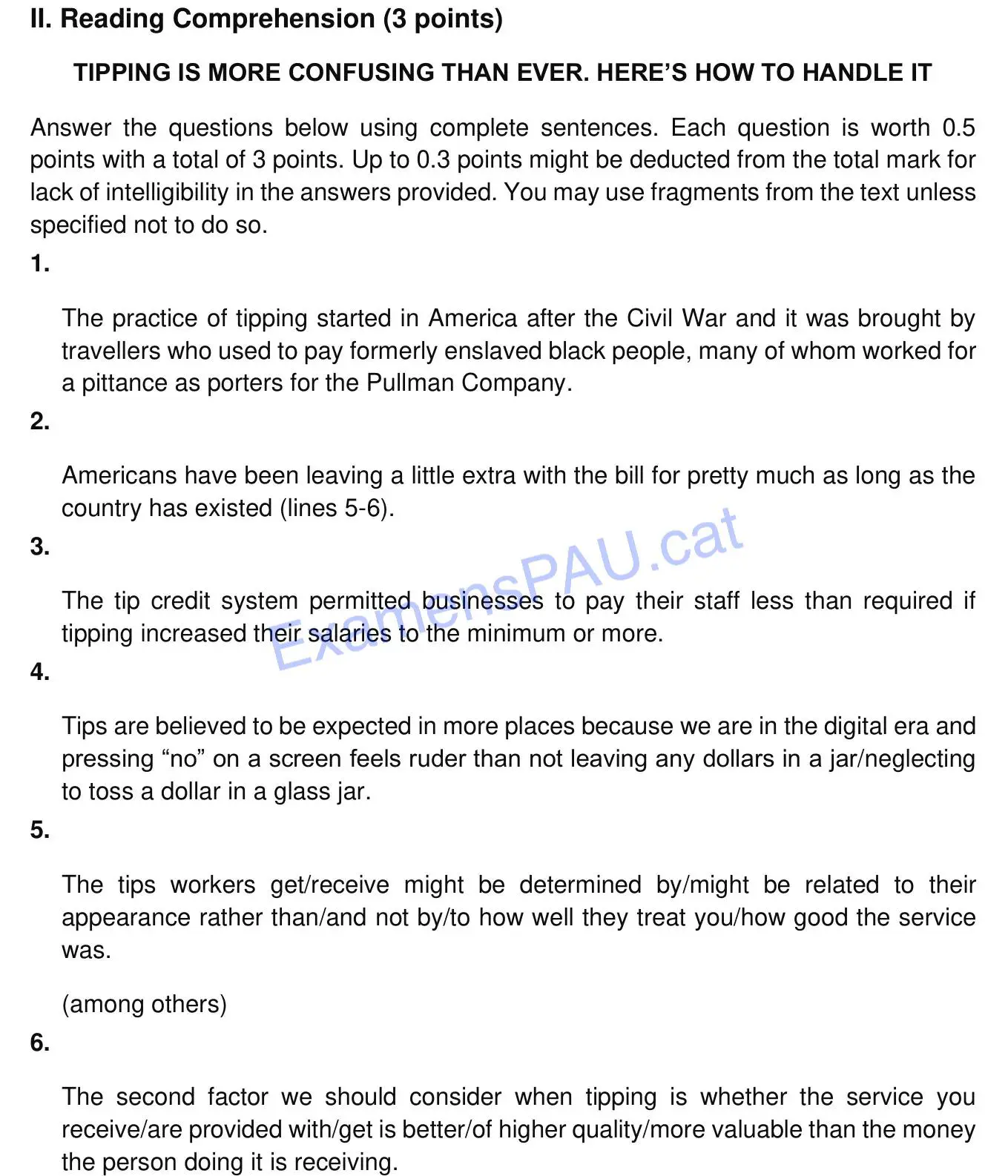
Part 2: Reading comprehension 10 15 20 25 30 35 40 TIPPING IS MORE CONFUSING THAN EVER. HERE'S HOW TO HANDLE IT Tipping has never been more confusing. Americans might always have disagreed on exactly how much to tip—20, 15, 10 percent?—but they generally knew where to do it. Now, tipping screens are popping up on iPads practically everywhere, and politicians are making things even harder by trying to adjust the laws around tipping. Americans have been leaving a little extra with the bill for pretty much as long as the country has existed. But the practice really only took off after the Civil War, when travelers abroad brought the custom home to pay formerly enslaved black people, many of whom worked for a pittance as porters for the Pullman Company. Eventually, when restaurants took off as an industry separate from hotels and boarding places, gratuity became popular there, too. When minimum wage laws arrived with the New Deal, it made sense to legislators to exempt workers in professions where the expected tips would account for the difference. Similar thinking held when Congress created the “tip credit” system in the 1960s: allowing businesses to pay tipped personnel a subminimum wage only as long as tips brought their earnings to or above the minimum. From there, tipping culture perpetuated itself. Americans know restaurant workers or, to a lesser extent, carwashers and hairdressers, legally don't take home enough money without tips, so the expectation that people will tip them has become customary. And as long as Americans keep tipping, the law can stay the same. Only recently, this status quo has become unstable. The laws started to change in the 2010s, when some cities, including D.C., and several states decided to experiment with cancelling the tip credit. Meanwhile, Congress passed legislation in 2018 allowing restaurants that pay servers the statutory minimum to redistribute any tips those employees do receive to back-of-house staff. Norms have changed, too, in more recent years—but in the opposite direction. Seventy-two percent of Americans said in a 2023 survey that they believe tips are expected in more places. That's thanks in part to the dawn of the digital payment era: pressing “no” on an iPad tip screen feels a lot ruder than neglecting to toss a dollar in a glass jar. There's plenty of reasons to wish tipping would disappear altogether. People's tips might depend on how they look rather than the quality of their service. The unpredictability of pay—a rainy night likely means a lighter wallet—means undue financial stress for the tipped worker. Cooks and dishwashers also end up worse off than servers, especially at higher-end establishments, regardless of skill. On the other hand, research suggests the existence of tipping may yield better service, at least here in the United States. And many restaurants have struggled to support themselves without the flexibility the system allows them. In short, tipping probably isn't going to disappear anytime soon, and something like the status quo is not necessarily bad. Where does that leave customers? One principle is simple: Where there's a subminimum wage, tip. The second factor to consider is more complicated and more personal: tip when someone is doing you a service that's worth more to you than the person serving you is getting for it. Maybe that is someone doing an average job in an above-average way—a locksmith who spends hours in the cold to let you in your house, or a barista with a flair for latte art. Or maybe its someone doing unpleasant work for very little—hotel cleaning staff remedying a big mess. What kind of tipper are you? Text adapted from an article by David SHiPLEY. The Washington Post [online] (September 23, 2024) pittance: misèria / miseria toss: llencar / lanzar QUESTIONS Answer the questions below using complete sentences. You may use fragments from the text unless specified not to do so. [8 points: 0.5 points for each correct answer. Up to 0.3 points might be deducted from the total mark for lack of intelligibility in the answers provided.] 1. 2. When and how did the practice of tipping start in America? Find a sentence in the text that corresponds to the following rewritten/paraphrased sentence: “Since the early days of the United States, people have routinely added a small bonus to their payments.” Explain the tip credit system that was created in the 1960s IN YOUR OWN WORDS. You may use the words pay, minimum and businesses. Why are tips believed to be expected in more places now? Rewrite/paraphrase the sentence: “People's tips might depend on how they look rather than the quality of their service” (lines 27-28). You may keep grammatical words (i.e. the, might, their, how, etc.) and the following words: tips, service. Explain IN YOUR OWN WORDS the second factor customers should consider when deciding whether to tip or not.