
Listening comprehension | Anglès
Exercicis PAU resolts de Listening comprehension d'Anglès. La prova avalua la comprensió de documents sonors en anglès: notícies, entrevistes o reportatges, amb preguntes sobre la idea principal i detalls concrets. Trobaràs els exercicis oficials de la Generalitat amb la solució inclosa.
#1 Exercici d'examen
Veure solució
Text de l'exercici (transcripció)
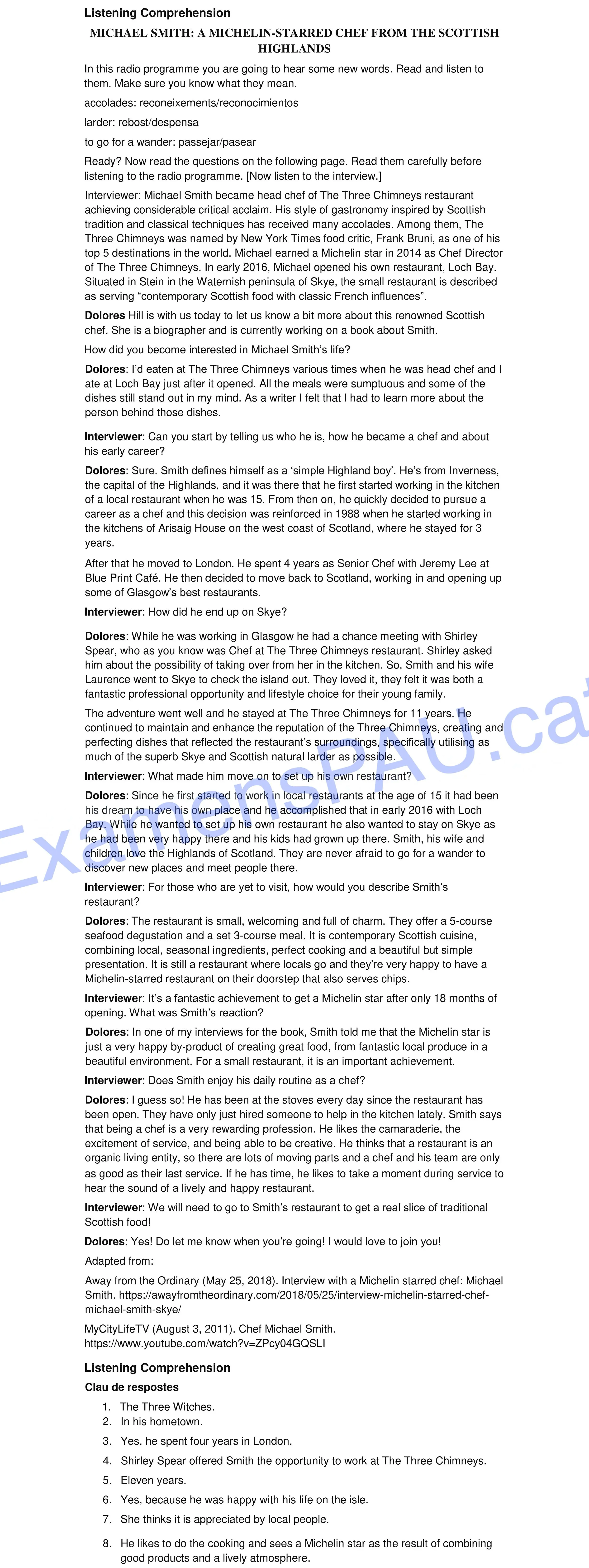
Part 1: Listening comprehension MICHAEL SMITH: A MICHELIN-STARRED CHEF FROM THE SCOTTISH HIGHLANDS In this radio programme you are going to hear some new words. Read and listen to them. Make sure you know what they mean. accolades: reconeixements / reconocimientos larder: rebost / despensa to go for a wander: passejar / pasear Ready? Now read the questions on the following page. Read them carefully before listening to the radio programme. [Now listen to the interview.] QUESTIONS Choose the best answer according to the recording. Only ONE answer is correct. [3 points: 0.375 points for each correct answer. Wrong answers will be penalized by deducting 0.125 points. There is no penalty for unanswered questions.] 1. In which of the following restaurants has Michael Smith NOT worked? The Three Chimneys. The Three Witches. Loch Bay. Blue Print Café. 2. Where did Michael Smith work in a kitchen for the first time? In the capital of Scotland. On the west coast of Scotland. In a village close to the Scottish Highlands. In his hometown. w Y id Michael Smith work in any restaurant kitchens outside Scotland? No, although he considered moving to London. No, he always worked in the Highlands and in Glasgow. Yes, he spent four years in London. Yes, he spent a few years at a café in France. 4. Which of the following statements is TRUE? Shirley Spear offered Smith the opportunity to work at The Three Chimneys. Smith did not want to work on Skye, because he felt it was very remote. Smith was looking for opportunities to work on Skye and contacted Shirley Spear to get advice. Smith's wife went to check Skye out, because she was unsure about the new lifestyle for her family. 5. How long did it take Smith to open his own restaurant after his arrival at Skye? Thirteen years. Fifteen years. Eleven years. Sixteen years. SN Y id he open his new restaurant on Skye? Yes, because he was happy with his life on the isle. Yes, but only because his kids asked him to do so. No, because his wife and children wanted to discover new places. Yes, because it had always been his dream to open a restaurant on Skye. 7. What does Dolores think about Smith's restaurant? She thinks it is a pity that they serve simple food, such as chips. She would prefer it to combine local products with international food. She thinks the presentation of dishes could be improved. She thinks it is appreciated by local people. 8. Which of the following best summarises Smith's view of his job? He prefers to get help in the kitchen to be able to enjoy the atmosphere of the restaurant. He likes to do the cooking and sees a Michelin star as the result of combining good products and a lively atmosphere. Sometimes he gets annoyed by the other people working and eating at the restaurant. He says being a chef is a rewarding profession since the job can be recognised with prizes such as a Michelin star.
#2 Exercici d'examen
Veure solució
Text de l'exercici (transcripció)
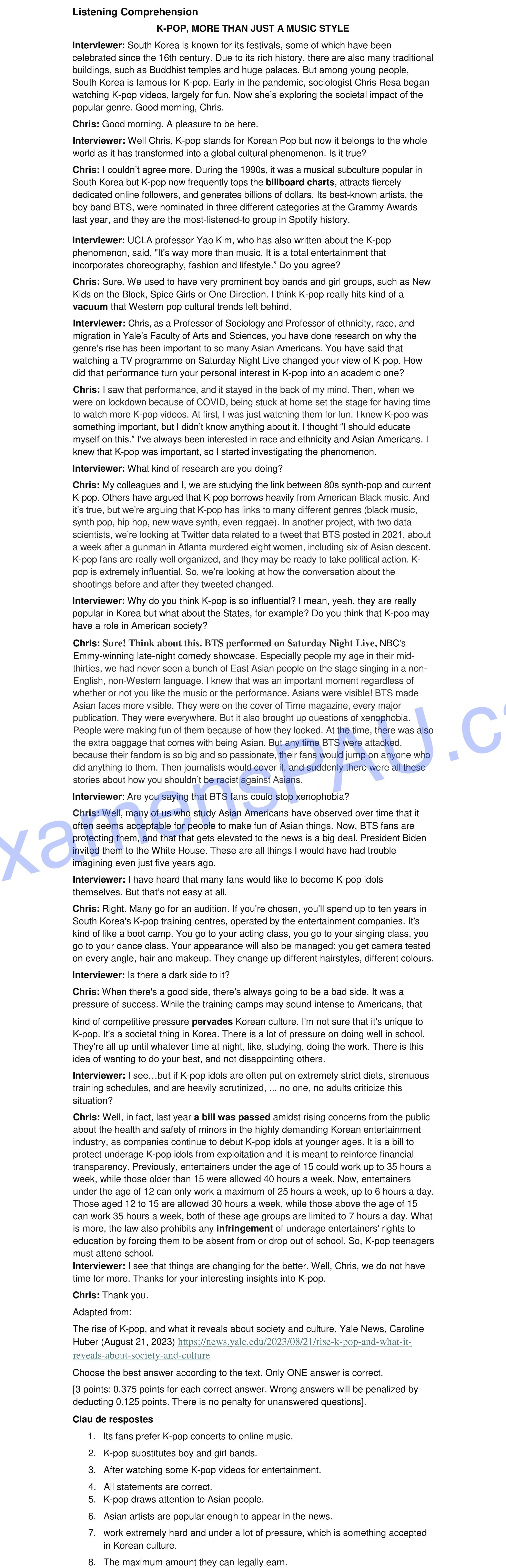
Part 1: Listening comprehension K-POP, MORE THAN JUST A MUSIC STYLE In this radio programme you are going to hear some new words. Read and listen to them. Make sure you know what they mean. billboard charts: llistes d'èxits musicals / listas de éxitos musicales vacuum: buit / vacío boot camp: camp d'entrenament / campo de entrenamiento pervades: impregna a bill was passed: una llei va ser aprovada / una ley fue aprobada infringement: infracció / infracción Ready? Now read the questions on the following page. Read them carefully before listening to the radio programme. [Now listen to the interview.] QUESTIONS Choose the best answer according to the recording. Only ONE answer is correct. [3 points: 0.375 points for each correct answer. Wrong answers will be penalized by deducting 0.125 points. There is no penalty for unanswered questions.] 1. Which of the following statements about K-pop is NOT mentioned in the interview? It makes a lot of money. It is usually on top of music charts. BTS, a famous K-pop band, broke a record on Spotify. Its fans prefer K-pop concerts to online music. 2. Why does Chris think K-pop is so popular these days? K-pop leaves behind boy and girl bands. K-pop substitutes boy and girl bands. K-pop taps into ethnicity and race. K-pop is only followed by Asian Americans. 3. When did Chris start being academically interested in K-pop? When K-pop artists appeared on the Internet. Just after lockdown, when she was on a leave. When she was studying race during the Covid lockdown. After watching some K-pop videos for entertainment. 4. Which of these aspects of K-pop is Chris investigating at the moment? The influence of K-pop artists on their fans and followers. The link between different types of music genres and K-pop. Whether K-pop fans may have a say in politics. All statements are correct. 5. Why does Chris believe that K-pop is so influential all over the world? The press interviews K-pop artists and publishes their concert dates. K-pop followers are mainly Asian who are not racist. K-pop draws attention to Asian people. K-pop artists were against xenophobia. 6. What has changed a lot in the last five years? K-pop fans are protecting their artists from the press. A president of the United States went to a K-pop concert. Asian artists are popular enough to appear in the news. People make fun of Asian Americans. N — f young people would like to become a K-pop idol, they must go for an audition and then attend training courses on diets and competition. have their pictures taken in their acting or singing classes and study a lot. criticize the classmates who are not doing well enough in their classes after tiring timetables. work extremely hard and under a lot of pressure, which is something accepted in Korean culture. 8. Which of the following is NOT mentioned in the law to protect R-pop idols? Going to school is mandatory. Training hours are limited according to age. The number of working hours per day is limited according to age. The maximum amount they can legally earn.
#3 Exercici d'examen
Veure solució
Text de l'exercici (transcripció)
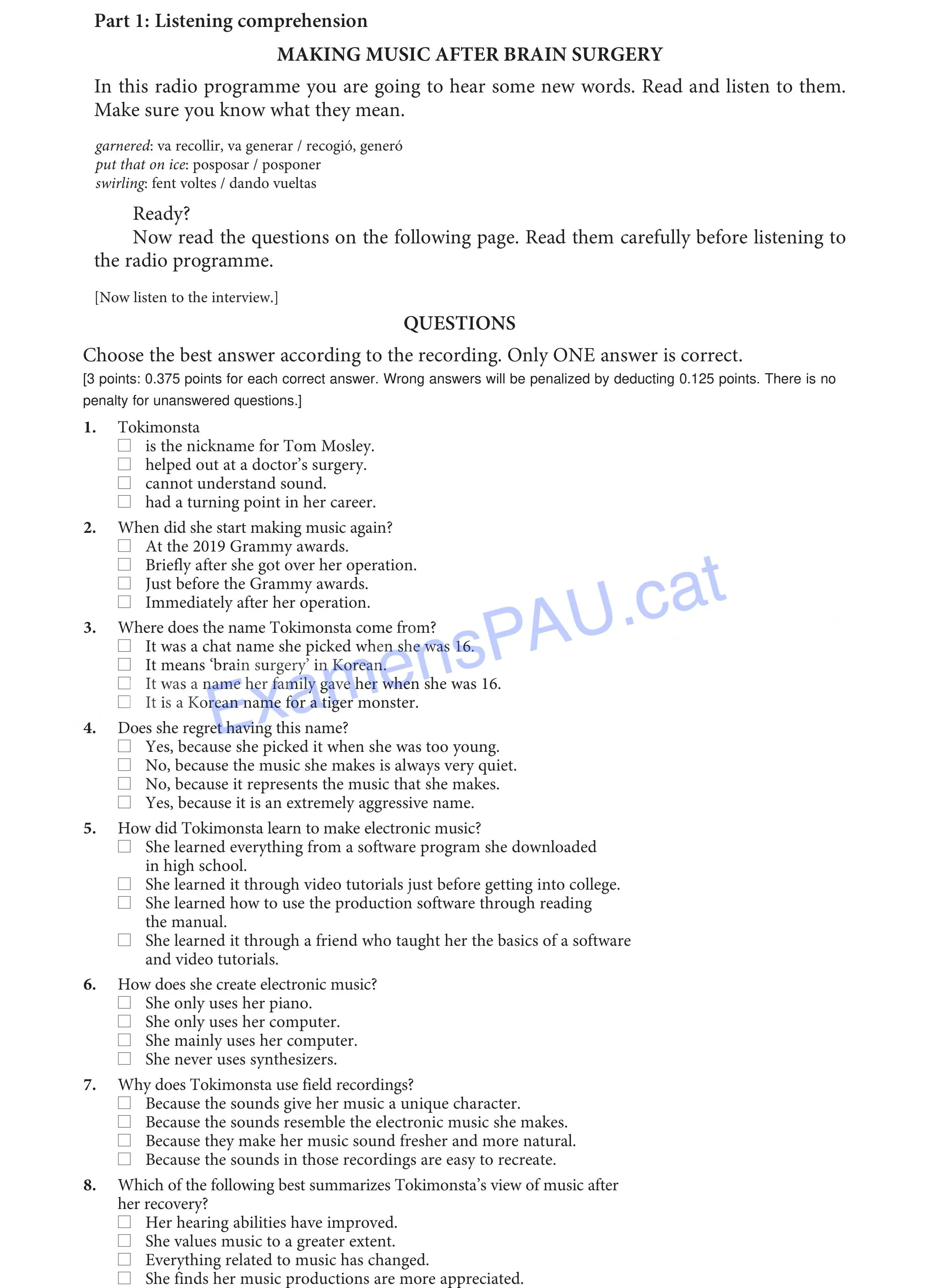
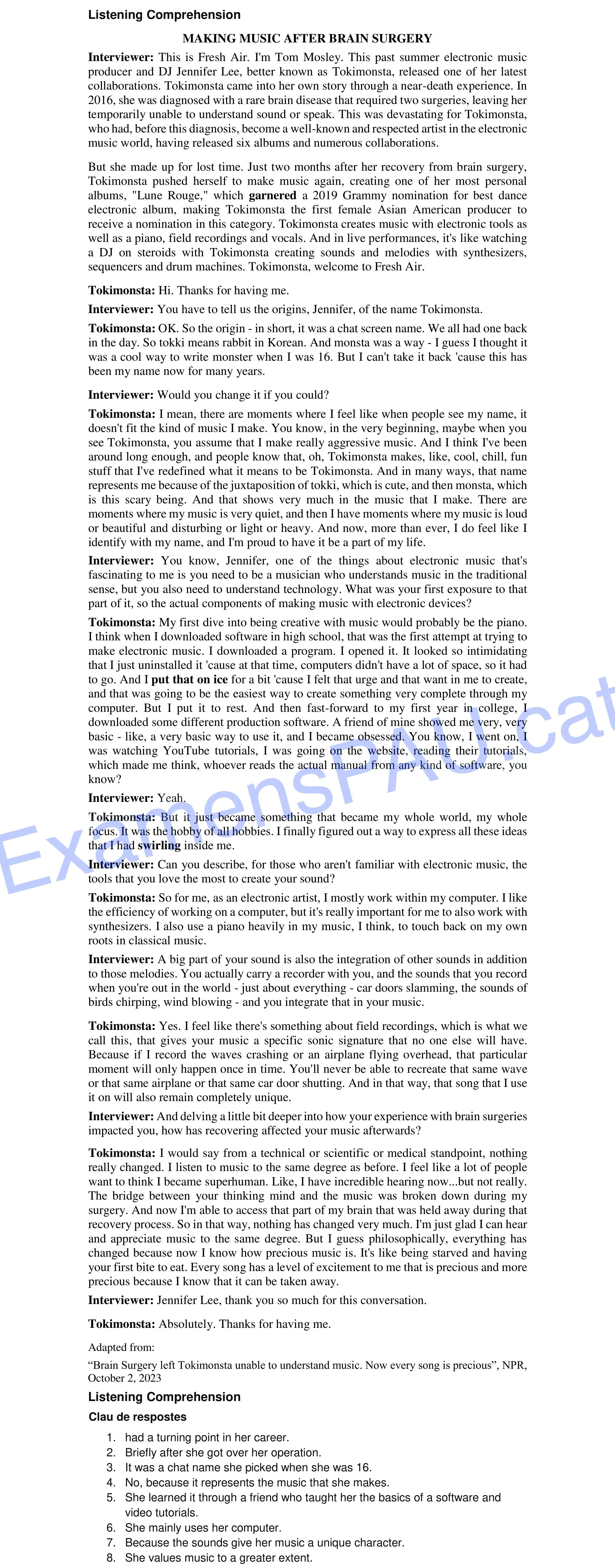
Part 1: Listening comprehension MARING MUSIC AFTER BRAIN SURGERY In this radio programme you are going to hear some new words. Read and listen to them. Make sure you know what they mean. garnered: va recollir, va generar / recogió, generó put that on ice: posposar / posponer swirling: fent voltes / dando vueltas Ready? Now read the questions on the following page. Read them carefully before listening to the radio programme. [Now listen to the interview. ] QUESTIONS Choose the best answer according to the recording. Only ONE answer is correct. [3 points: 0.375 points for each correct answer. Wrong answers will be penalized by deducting 0.125 points. There is no penalty for unanswered questions.] 1. Tokimonsta is the nickname for Tom Mosley. helped out at a doctor's surgery. cannot understand sound. had a turning point in her career. 2. When did she start making music again? At the 2019 Grammy awards. Briefly after she got over her operation. Just before the Grammy awards. Immediately after her operation. 3. Where does the name Tokimonsta come from? It was a chat name she picked when she was 16. It means “brain surgery” in Korean. It was a name her family gave her when she was 16. Itis a Korean name for a tiger monster. 4. Does she regret having this name? Yes, because she picked it when she was too young. No, because the music she makes is always very quiet. No, because it represents the music that she makes. Yes, because it is an extremely aggressive name. 5. How did Tokimonsta learn to make electronic music? She learned everything from a software program she downloaded in high school. She learned it through video tutorials just before getting into college. She learned how to use the production software through reading the manual. She learned it through a friend who taught her the basics of a software and video tutorials. 6. How does she create electronic music? She only uses her piano. She only uses her computer. She mainly uses her computer. She never uses synthesizers. 7. Why does Tokimonsta use field recordings? Because the sounds give her music a unique character. Because the sounds resemble the electronic music she makes. Because they make her music sound fresher and more natural. Because the sounds in those recordings are easy to recreate. 8. Which of the following best summarizes Tokimonsta's view of music after her recovery? Her hearing abilities have improved. She values music to a greater extent. Everything related to music has changed. She finds her music productions are more appreciated.
#4 Exercici d'examen
Veure solució
Text de l'exercici (transcripció)
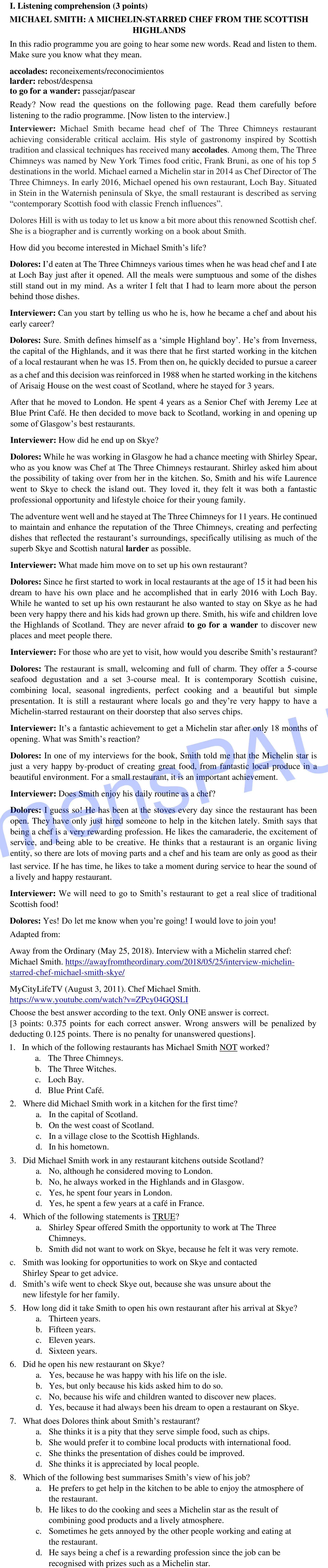
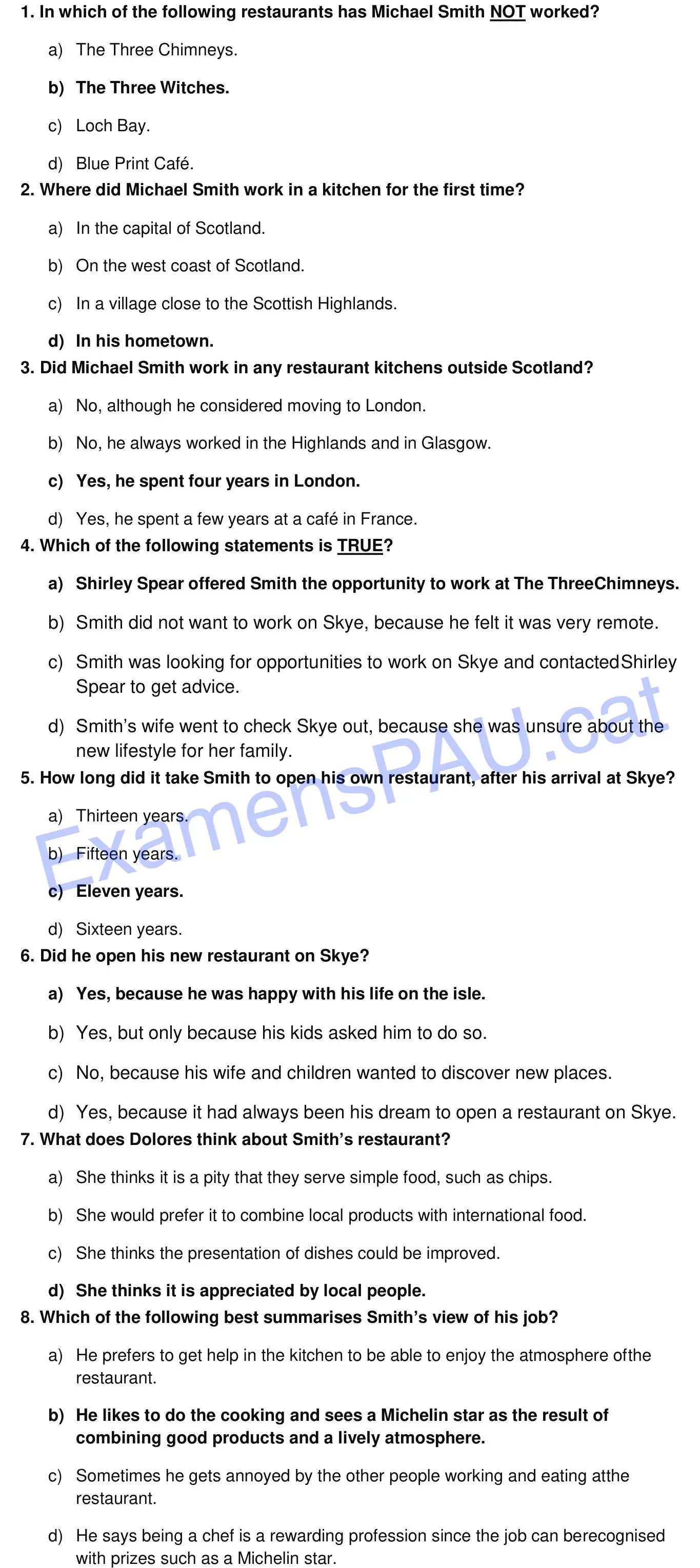
I. Listening comprehension (3 points) MICHAEL SMITH: A MICHELIN-STARRED CHEF FROM THE SCOTTISH HIGHLANDS In this radio programme you are going to hear some new words. Read and listen to them. Make sure you know what they mean. accolades: reconeixements/reconocimientos larder: rebost/despensa to go for a wander: passejar/pasear Ready? Now read the questions on the following page. Read them carefully before listening to the radio programme. [Now listen to the interview. ] Interviewer: Michael Smith became head chef of The Three Chimneys restaurant achieving considerable critical acclaim. His style of gastronomy inspired by Scottish tradition and classical techniques has received many accolades. Among them, The Three Chimneys was named by New York Times food critic, Frank Bruni, as one of his top 5 destinations in the world. Michael earned a Michelin star in 2014 as Chef Director of The Three Chimneys. In early 2016, Michael opened his own restaurant, Loch Bay. Situated in Stein in the Waternish peninsula of Skye, the small restaurant is described as serving “contemporary Scottish food with classic French influences”. Dolores Hill is with us today to let us know a bit more about this renowned Scottish chef. She is a biographer and is currently working on a book about Smith. How did you become interested in Michael Smith's life? Dolores: l'd eaten at The Three Chimneys various times when he was head chef and I ate at Loch Bay just after it opened. All the meals were sumptuous and some of the dishes still stand out in my mind. As a writer I felt that I had to learn more about the person behind those dishes. Interviewer: Can you start by telling us who he is, how he became a chef and about his early career? Dolores: Sure. Smith defines himself as a “simple Highland boy”. He”s from Inverness, the capital of the Highlands, and it was there that he first started working in the kitchen of a local restaurant when he was 15. From then on, he quickly decided to pursue a career as a chef and this decision was reinforced in 1988 when he started working in the kitchens of Arisaig House on the west coast of Scotland, where he stayed for 3 years. After that he moved to London. He spent 4 years as a Senior Chef with Jeremy Lee at Blue Print Café. He then decided to move back to Scotland, working in and opening up some of Glasgow”s best restaurants. Interviewer: How did he end up on Skye? Dolores: While he was working in Glasgow he had a chance meeting with Shirley Spear, who as you know was Chef at The Three Chimneys restaurant. Shirley asked him about the possibility of taking over from her in the kitchen. So, Smith and his wife Laurence went to Skye to check the island out. They loved it, they felt it was both a fantastic professional opportunity and lifestyle choice for their young family. The adventure went well and he stayed at The Three Chimneys for 11 years. He continued to maintain and enhance the reputation of the Three Chimneys, creating and perfecting dishes that reflected the restaurant's surroundings, specifically utilising as much of the superb Skye and Scottish natural larder as possible. Interviewer: What made him move on to set up his own restaurant? Dolores: Since he first started to work in local restaurants at the age of 15 it had been his dream to have his own place and he accomplished that in early 2016 with Loch Bay. While he wanted to set up his own restaurant he also wanted to stay on Skye as he had been very happy there and his kids had grown up there. Smith, his wife and children love the Highlands of Scotland. They are never afraid to go for a wander to discover new places and meet people there. Interviewer: For those who are yet to visit, how would you describe Smith's restaurant? Dolores: The restaurant is small, welcoming and full of charm. They offer a 5-course seafood degustation and a set 3-course meal. It is contemporary Scottish cuisine, combining local, seasonal ingredients, perfect cooking and a beautiful but simple presentation. It is still a restaurant where locals go and they're very happy to have a Michelin-starred restaurant on their doorstep that also serves chips. Interviewer: It's a fantastic achievement to get a Michelin star after only 18 months of opening. What was Smith's reaction? Dolores: In one of my interviews for the book, Smith told me that the Michelin star is just a very happy by-product of creating great food, from fantastic local produce in a beautiful environment. For a small restaurant, it is an important achievement. Interviewer: Does Smith enjoy his daily routine as a chef? Dolores: I guess so! He has been at the stoves every day since the restaurant has been open. They have only just hired someone to help in the kitchen lately. Smith says that being a chef is a very rewarding profession. He likes the camaraderie, the excitement of service, and being able to be creative. He thinks that a restaurant is an organic living entity, so there are lots of moving parts and a chef and his team are only as good as their last service. If he has time, he likes to take a moment during service to hear the sound of a lively and happy restaurant. Interviewer: We will need to go to Smith's restaurant to get a real slice of traditional Scottish food! Dolores: Yes! Do let me know when you're going! I would love to join you! Adapted from: Away from the Ordinary (May 25, 2018). Interview with a Michelin starred chef: Michael Smith. https://awayfromtheordinary.com/2018/05/25/interview-michelin- starred-chef-michael-smith-skye/ MyCityLifeTV (August 3, 2011). Chef Michael Smith. https://www.youtube.com/watch?v=ZPcy04GQSLI Choose the best answer according to the text. Only ONE answer is correct. [3 points: 0.375 points for each correct answer. Wrong answers will be penalized by deducting 0.125 points. There is no penalty for unanswered questions]. 1. In which of the following restaurants has Michael Smith NOT worked? a. The Three Chimneys. b. The Three Witches. c. Loch Bay. d. Blue Print Café. 2. Where did Michael Smith work in a kitchen for the first time? a. In the capital of Scotland. b. On the west coast of Scotland. c. In a village close to the Scottish Highlands. d. In his hometown. 3. Did Michael Smith work in any restaurant kitchens outside Scotland? a. No, although he considered moving to London. b. No, he always worked in the Highlands and in Glasgow. c. Yes, he spent four years in London. d. Yes, he spent a few years at a café in France. 4. Which of the following statements is TRUE? a. Shirley Spear offered Smith the opportunity to work at The Three Chimneys. b. Smith did not want to work on Skye, because he felt it was very remote. c. Smith was looking for opportunities to work on Skye and contacted Shirley Spear to get advice. d. Smith's wife went to check Skye out, because she was unsure about the new lifestyle for her family. 5. How long did it take Smith to open his own restaurant after his arrival at Skye? a. Thirteen years. b. Fifteen years. c. Eleven years. d. Sixteen years. 6. Did he open his new restaurant on Skye? a. Yes, because he was happy with his life on the isle. b. Yes, but only because his kids asked him to do so. c. No, because his wife and children wanted to discover new places. d. Yes, because it had always been his dream to open a restaurant on Skye. 7. What does Dolores think about Smith's restaurant? a. She thinks it is a pity that they serve simple food, such as chips. b. She would prefer it to combine local products with international food. c. She thinks the presentation of dishes could be improved. d. She thinks it is appreciated by local people. 8. Which of the following best summarises Smith”s view of his job? a. He prefers to get help in the kitchen to be able to enjoy the atmosphere of the restaurant. b. He likes to do the cooking and sees a Michelin star as the result of combining good products and a lively atmosphere. c. Sometimes he gets annoyed by the other people working and eating at the restaurant. d. He says being a chef is a rewarding profession since the job can be recognised with prizes such as a Michelin star.
#5 Exercici d'examen
Veure solució
Text de l'exercici (transcripció)
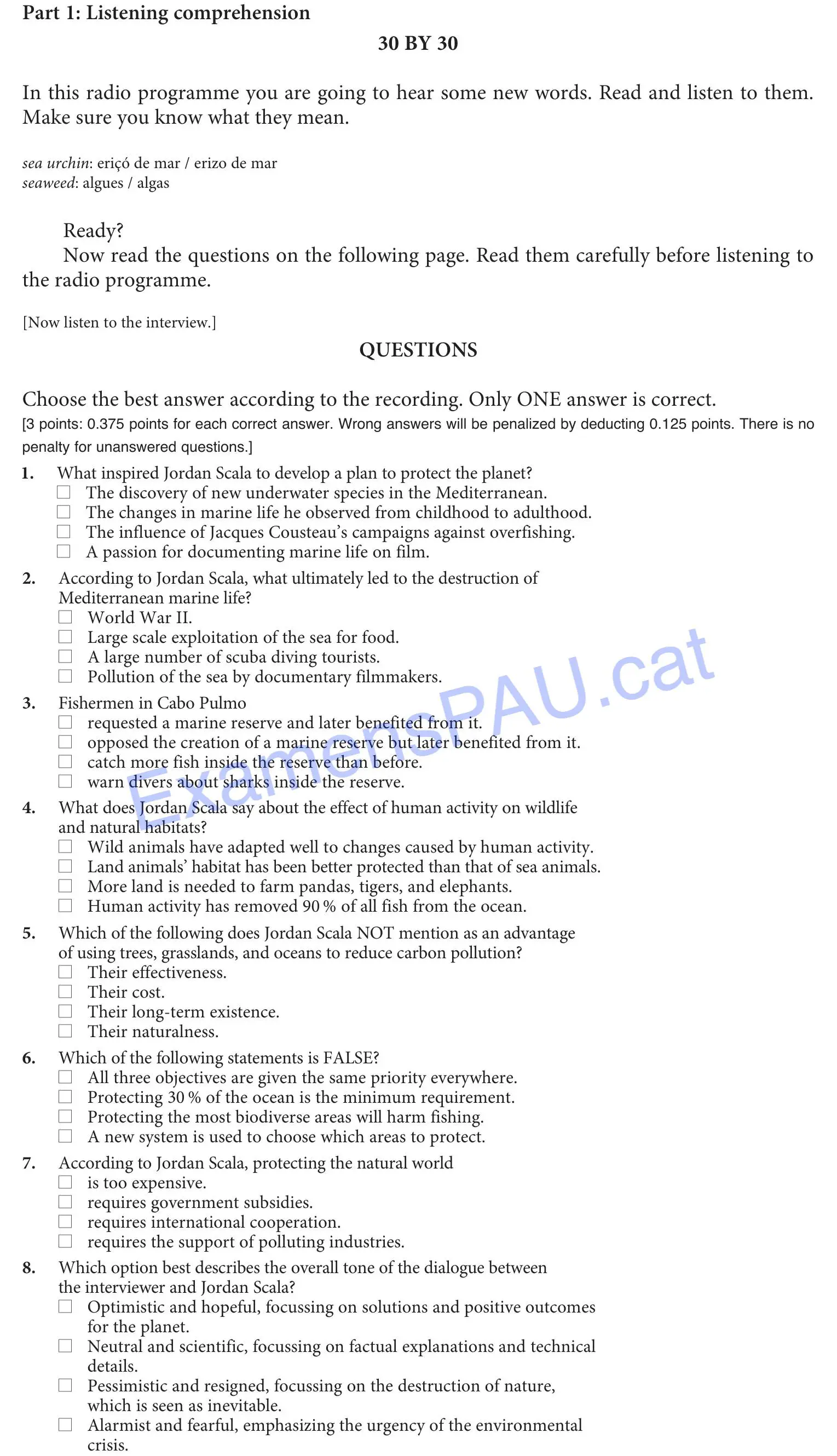
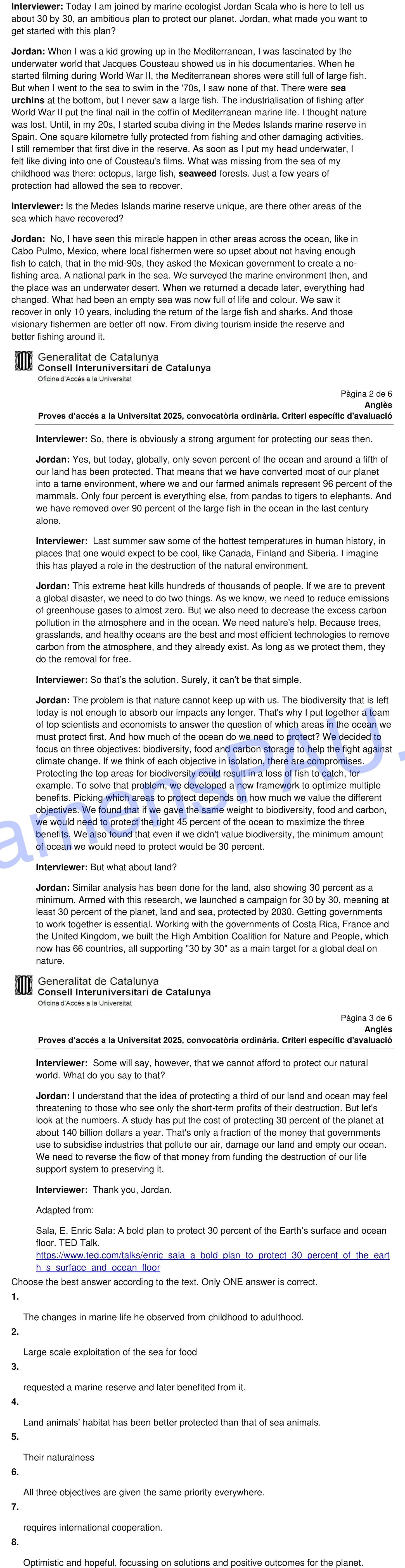
Part 1: Listening comprehension 30 BY 30 In this radio programme you are going to hear some new words. Read and listen to them. Make sure you know what they mean. sea urchin: erigó de mar / erizo de mar seaweed: algues / algas Ready? Now read the questions on the following page. Read them carefully before listening to the radio programme. [Now listen to the interview.] QUESTIONS Choose the best answer according to the recording. Only ONE answer is correct. [8 points: 0.375 points for each correct answer. Wrong answers will be penalized by deducting 0.125 points. There is no penalty for unanswered questions. ] 1. What inspired Jordan Scala to develop a plan to protect the planet? The discovery of new underwater species in the Mediterranean. The changes in marine life he observed from childhood to adulthood. The influence of Jacques Cousteau's campaigns against overfishing. A passion for documenting marine life on film. 2. According to Jordan Scala, what ultimately led to the destruction of Mediterranean marine life? World War IL Large scale exploitation of the sea for food. A large number of scuba diving tourists. Pollution of the sea by documentary filmmakers. 3. Fishermen in Cabo Pulmo requested a marine reserve and later benefited from it. opposed the creation of a marine reserve but later benefited from it. catch more fish inside the reserve than before. warn divers about sharks inside the reserve. 4. What does Jordan Scala say about the effect of human activity on wildlife and natural habitats? Wild animals have adapted well to changes caused by human activity. Land animals” habitat has been better protected than that of sea animals. More land is needed to farm pandas, tigers, and elephants. Human activity has removed 90% of all fish from the ocean. 5. Which of the following does Jordan Scala NOT mention as an advantage of using trees, grasslands, and oceans to reduce carbon pollution? Their effectiveness. Their cost. Their long-term existence. Their naturalness. 6. Which of the following statements is FALSE? All three objectives are given the same priority everywhere. Protecting 30 % of the ocean is the minimum requirement. Protecting the most biodiverse areas will harm fishing. A new system is used to choose which areas to protect. 7. According to Jordan Scala, protecting the natural world is too expensive. requires government subsidies. requires international cooperation. requires the support of polluting industries. 8. Which option best describes the overall tone of the dialogue between the interviewer and Jordan Scala? Optimistic and hopeful, focussing on solutions and positive outcomes for the planet. Neutral and scientific, focussing on factual explanations and technical details. Pessimistic and resigned, focussing on the destruction of nature, which is seen as inevitable. Alarmist and fearful, emphasizing the urgency of the environmental crisis.
#6 Exercici d'examen
Veure solució
Text de l'exercici (transcripció)
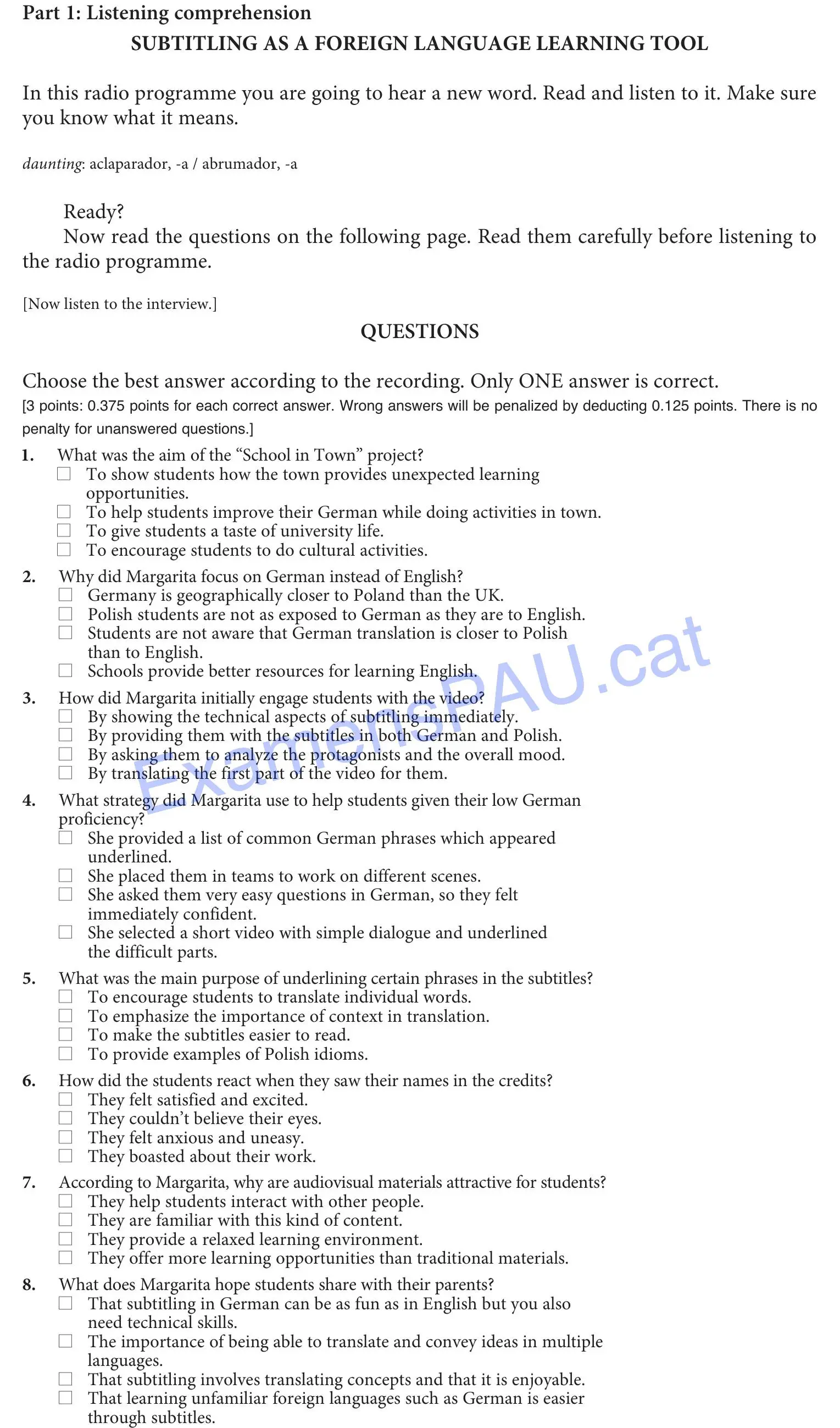
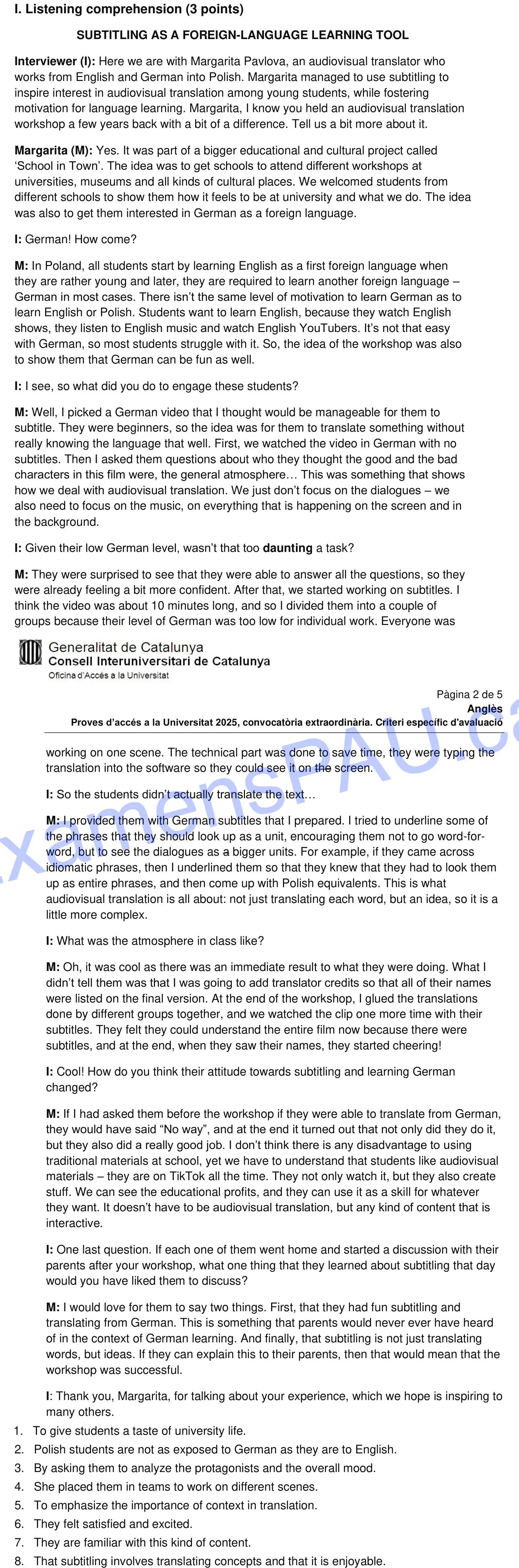
Part 1: Listening comprehension SUBTITLING AS A FOREIGN LANGUAGE LEARNING TOOL In this radio programme you are going to hear a new word. Read and listen to it. Make sure you know what it means. daunting: aclaparador, -a / abrumador, -a Ready? Now read the questions on the following page. Read them carefully before listening to the radio programme. [Now listen to the interview.] QUESTIONS Choose the best answer according to the recording. Only ONE answer is correct. [8 points: 0.375 points for each correct answer. Wrong answers will be penalized by deducting 0.125 points. There is no penalty for unanswered questions.] 1. What was the aim of the "School in Town” project? To show students how the town provides unexpected learning opportunities. To help students improve their German while doing activities in town. To give students a taste of university life. To encourage students to do cultural activities. 2. Why did Margarita focus on German instead of English? Germany is geographically closer to Poland than the UK. Polish students are not as exposed to German as they are to English. Students are not aware that German translation is closer to Polish than to English. Schools provide better resources for learning English. 3. How did Margarita initially engage students with the video? By showing the technical aspects of subtitling immediately. By providing them with the subtitles in both German and Polish. By asking them to analyze the protagonists and the overall mood. By translating the first part of the video for them. 4. What strategy did Margarita use to help students given their low German proficiency? She provided a list of common German phrases which appeared underlined. She placed them in teams to work on different scenes. She asked them very easy questions in German, so they felt immediately confident. She selected a short video with simple dialogue and underlined the difficult parts. 5. What was the main purpose of underlining certain phrases in the subtitles? To encourage students to translate individual words. To emphasize the importance of context in translation. To make the subtitles easier to read. To provide examples of Polish idioms. 6. How did the students react when they saw their names in the credits? They felt satisfied and excited. They couldn't believe their eyes. They felt anxious and uneasy. They boasted about their work. 7. According to Margarita, why are audiovisual materials attractive for students? They help students interact with other people. They are familiar with this kind of content. They provide a relaxed learning environment. They offer more learning opportunities than traditional materials. 8. What does Margarita hope students share with their parents? That subtitling in German can be as fun as in English but you also need technical skills. The importance of being able to translate and convey ideas in multiple languages. That subtitling involves translating concepts and that it is enjoyable. That learning unfamiliar foreign languages such as German is easier through subtitles.
#7 Exercici d'examen

Veure solució
Text de l'exercici (transcripció)
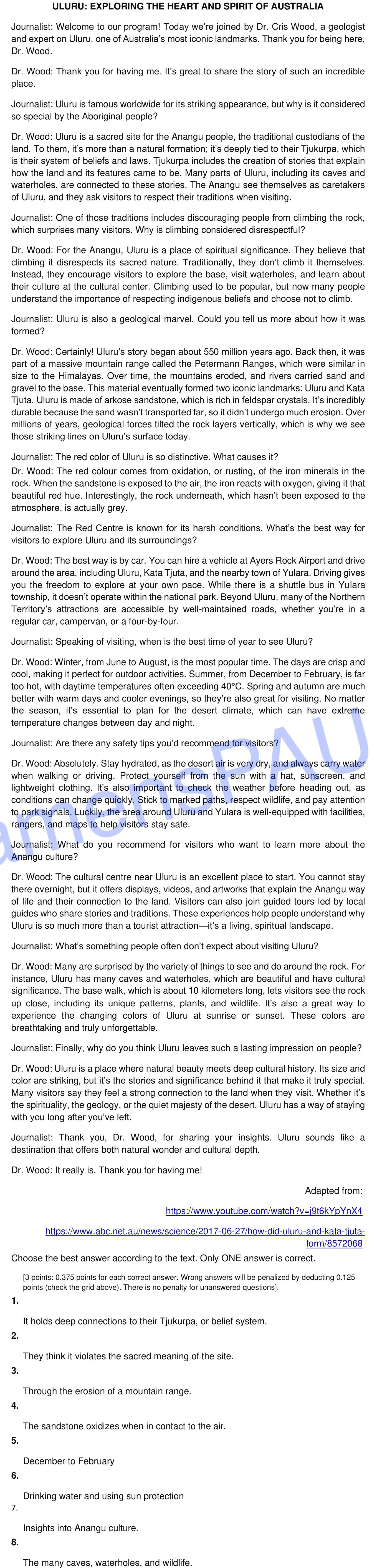
Part 1: Listening comprehension ULURU: EXPLORING THE HEART AND SPIRIT OF AUSTRALIA In this radio programme you are going to hear some new words. Read and listen to them. Make sure you know what they mean. sandstone: pedra arenosa / piedra arenisca layers: capes / capas tilted: inclinat / inclinado hue: tonalitat / tonalidad Ready? Now read the questions on the following page. Read them carefully before listening to the radio programme. [Now listen to the interview.] QUESTIONS Choose the best answer according to the recording. Only ONE answer is correct. [8 points: 0.375 points for each correct answer. Wrong answers will be penalized by deducting 0.125 points. There is no penalty for unanswered questions.] 1. Whyis Uluru considered sacred by the Anangu people? It is made of a rare type of sandstone. It holds deep connections to their Tjukurpa, or belief system. It is the deepest natural formation in Australia. It was used as a meeting point for caretakers. 2. Why do the Anangu discourage ascending Uluru? It poses significant risks to visitors. They encourage exploring other cultural experiences instead. They think it violates the sacred meaning of the site. There are no established trails to follow. 3. According to Chris Wood, how did Uluru form? In the same way as the Himalayas. Through the erosion of a mountain range. Through the petrification of an ancient sea. From the gradual accumulation of desert sand. 4. Whyis Uluru red? It contains copper minerals. The sandstone oxidizes when in contact to the air. It is actually grey, not red. The soil around it stains the rock. 5. When is the worst time to visit Uluru? December to February. June to August. March to May. September to November. 6. What safety precautions are important when visiting Uluru? Avoiding interactions with local wildlife. Drinking water and using sun protection. Hiring a ranger or tour guide. Avoiding travel in the winter months. 7. What does the Uluru Cultural Center offer visitors? Accommodation for overnight stays. Guided tours of the rock base. Insights into Anangu culture. Spiritual support. 8. What surprises visitors about Uluru's surroundings? The absence of vegetation. The many caves, waterholes, and wildlife. The availability of tourist shops and restaurants. The lack of walking paths around the base.